
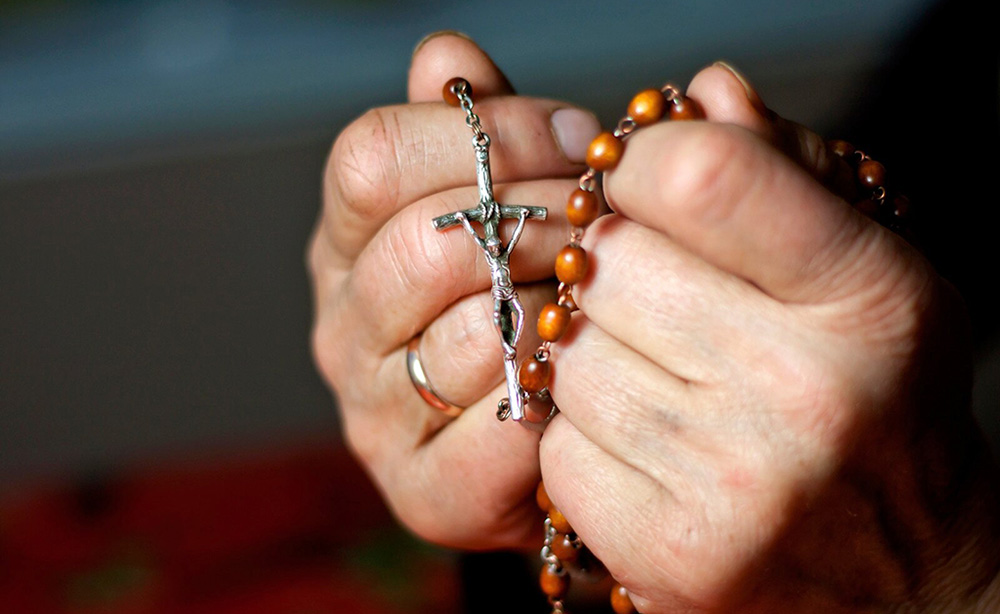

Editor’s Note: Each October, Catholics celebrate a month dedicated to the Rosary, highlighted by the Feast of Our Lady of the Rosary on October 7. This year, the Jesuit Media Lab will offer several creative works connected to the Rosary, beginning with this piece written by the poet and author Phil Metres.
+
⬤
The day I made my First Communion, holding my hands out for that small, dry taste of God, I also received my first rosary. I pulled it out of the little box and held it — a loop of cold, black, plastic beads linked by soft metal, affixed to a cross. Seven years old, I got through a couple of prayers, but then I placed it back in the box, where it’s remained since, coiled like a boa dozing behind zoo glass.
⬤
Forty year later, I received one from an Irish friend who’d just come back from Lourdes. The rosary was made by Palestinian Christians, carved from the olive wood of Bethlehem. The beads are variegated and rough to the touch, as if speaking to fingers in another tongue. Remember, the note inside the box reads, the infinite tenderness of God. I prayed with it once in a soporific state, as the green land of Ireland unfolded outside the wide bus window between Belfast and Achill Island. Once, but only once, before it was tucked in a drawer.
⬤
It was with the third rosary that I found my way inside. Each bead like a set of doors, opening in me, opening me. It — and I— suddenly blessed by Pope Francis in 2023, into whose presence I stumbled, my tongue numb. I’d been running from my cradle Catholicism for years, I thought, but suddenly I won an award for the Catholic Imagination, and the next thing I knew, I’d been folded into a chain of people and events that led into the Vatican. I’d thought of my imagination as a wild thing, a flight from the Pharaoh of the faith, but there I was, rushing into a local religious store around the corner to buy not one, but a bag of rosaries, before meeting the pontiff, red-beaded rosaries with an image of Francis. Years later, those rosaries still waft incense.
⬤
⬤
Ω
“Catholic Imagination?!” my father exclaimed, laughing. “Don’t cha just follow the rules?!” He was joking, but not entirely. That was the church he was born into and shaped by, a church of rules and rote prayers. Like the rosary.
⬤
It’s one of the most important symbols of faith, Mom says. From the Latin, rosarium, a garden of roses. Inside its gate is a garden.
She doesn’t like that I refer to my first rosary as a coiled boa constrictor. It was a gift from her.
Then she confesses that she never really liked saying the Rosary. Even when she was in the convent.
Perhaps I should be grateful that she didn’t. I wouldn’t be here if she’d stayed.
⬤
And also, I’ve just learned that rosary as an object is in the lowercase, while the Rosary prayer is written in the uppercase — as if it becomes something new and vital in the saying of it.
Okay, hang on, my Buddhist friend says, explain it to us “heathens.” Is the rosary just a bunch of beads on a string? Like a mala?
Well, yes and no. It’s a bunch of beads on a circular string, with a tail with some more beads, leading to a cross.
⬤
Beads, of course, are not just beads. In English, bead comes from the Old English bede, meaning a prayer. Each of these beads, a bede.
An ancient Minoan adorant, depicted in a 17th-century B.C. fresco at Akrotiri in Santorini, holds out a red string of beads.
The Desert Fathers and Mothers, ascetics who withdrew from the world to commit to a life of prayer, often prayed 150 psalms a day, using pebbles in a bowl. Anthony of Egypt used a prayer rope with 150 knots.
Centuries after the Desert Fathers and Mothers — it’s difficult to know precisely when, though perhaps a thousand years later, the beads became formalized into the rosary.
⬤
Directions for praying the Rosary:
Begin by touching the crucifix (or cross) and praying the Apostles Creed.
Then, on the first bead, you pray an Our Father. The Hail Mary is prayed on the next three beads. Then, at the next separated bead, the Glory Be prayer, a simple praise to the Triune God:
Glory be to the Father
and to the Son
and to the Holy Spirit,
as it was in the beginning
is now, and ever shall be
world without end.
Amen.
Making your way around the ring, there are five decades, divided by four separated beads, on which the Our Father is prayed, plus a Glory Be, and, I learned for the first time the other day, praying with some students at my college, the Fatima Prayer.
Making our way back to the center, close to the cross, a final prayer: Hail Holy Queen.
Overall, it’s 60-plus, more or less, the vast majority of them — 53 — are to Mary.
⬤
Hail Mary, full of grace,
the Lord is with Thee.
Blessed art Thou Among Women
Holy Mary, Mother of God,
and blessed is the fruit of Thy Womb, Jesus.
pray for us sinners,
now and at the hour of our death.
Amen.
⬤
Isn’t rote prayer — particularly an old prayer like the Hail Mary — stiflingly boring and unimaginative, particularly for a poet used to creating one’s own way through new words?
It can be. But aren’t mantras, memorized poems, attempts to focus and slow the mind, a stay from the confusing moment, a pressing of attention to the language at hand, residing inside its syllables of centering and entreaty?
From its inception, the Rosary was an alternative to the breviary, the book of psalms and prayers that priests and members of religious orders pray daily. The Rosary didn’t require literacy, knowledge or even a book. Just knowing the prayers by heart.
⬤
Often, one kneels to pray the Rosary. The Greeks and Romans thought it dishonorable, even barbaric, to kneel. To kneel is to bend, to yield one’s strength. Yet the word proskynein, to kneel, appears 59 times in the New Testament. It’s an invitation to submit to the Almighty.
Abba Apollo, who lived in a cave, prayed unceasingly and “bent his knees one hundred times by night and the same number of times each day.”
A lifetime ago, a set of knees ago, my father was in the Sodality of Our Lady. He and his hallmates would kneel on the hard floor of Wheeler Hall and hold the beads in their lifted hands, praying the Rosary.
⬤
Desert Mother Amma Syncletica of Alexandria: “There are many who live in the mountains and behave as if they were in the town; they are wasting their time. It is possible to be a solitary in one’s mind while living in a crowd; and it is possible for those who are solitaries to live in the crowd of their own thoughts.”
To thin that crowd of thoughts, the Rosary proposes, flood the packed and dusty streets of the mind with words, a constant stream of prayer.
⬤
Years ago, between rosaries, I was gifted a misbahah — a ring of dark blue square prayer beads — from a Palestinian in the village of Toura, suddenly a member of my extended family after my sister’s wedding. He’d noticed I was admiring them around his wrist, how he touched them between his forefinger and thumb. He immediately pressed the beads into my palm. I didn’t realize their purpose until later: to say the 99 names of God. Three times through the 33 beads. Years later, I would touch them, rummaging through my sock drawer, feeling their cold blueness, murmuring the many names of God.
St. Paul writes, “So a body is one though it has many parts, and all the parts of the body, though, many, one body. Each of us, part of some greater whole. Each prayer, a bone of the skeleton of spirit.”
⬤
⬤
In high school, my mother was in a sodality for Mary, a student group dedicated to promote spiritual growth. She tells me that she would say was a “decade” — 10 Hail Marys — if there was something she really wanted.
A decade, which I have come to learn, is pronounced “DECK-id.” I have yet to discover why.
Deck-id. Probably half my prayers when I was a teen were attempts to deck or duck my id. To stop from falling into the fiery pits of my own imaginings.
⬤
Mom’s Mom, Grandma Sheila, would say three Hail Marys and pray to St. Jude, because he apparently would listen to “impossible cases.”
I have often felt like an impossible case. I resist the rigidity of religion. I resist the obedience of rule-following because I too easily follow rules. I may appear to be a good boy; for example, I was the one who, as a seventh grader, offered myself up for detention because our art class had tormented the substitute teacher the previous day. I was not one of the perpetrators, but I became a junior high sacrifice. Even Jesus would have rolled his eyes at me.
⬤
But in my heart, I rebel. I say to God, as Augustine did, change me, but “not yet.” A confession: I resist the exclusionary vibes of religion. I hate the idea of hell. Of people being punished by an angry, vengeful God. The very idea that I’m writing an essay about the rosary would have struck my younger selves in the following ways:
Ages 1-12: boring af.
Ages 13-22: uncool af.
Ages 22-to the present: crazy af.
The present: what is even happening right now.
⬤
The Hail Mary prayer evolved over one thousand years, solidifying in 1555 with its final plea added by St. Peter Canisius.
The Hail Mary itself is stitched from three threads.
The first two lines come from the Gospel of Luke, when Mary is visited and greeted by the angel Gabriel.
The second two lines (minus the Jesus), also from the Gospel of Luke, are spoken by Elizabeth when her cousin Mary comes, full with child.
The last thread is the petition, what we ask — for Mary’s intercession, from this moment until we die. It was added in the late 15th century in Italy, when the world felt like it was ending.
The petition reminds me of the great ascetic prayer to Jesus that originated in the 5th century Egyptian desert: “Lord Jesus Christ, have mercy on me, a sinner.”
The church moves slowly, its heart so slow it beats once every decade. But prayers can change. Religion does not stand still.
⬤
In some respects, the Hail Mary follows the “collect” (pronounced “COLL-ect) form which, according to Pádraig Ó Tuama, contains a fivefold structure. Naming the addressee of the prayer, describing the addressee’s attributes, naming one desire, unfolding that desire and ending. Here, that’s 1) Mary, 2) full of grace, blessed, Mother of God, 3) pray for us, 4) now and at the hour of our death, 5) Amen.
⬤
Thinking of the Hail Mary as a collect reminds me of my principal dispute with it as a prayer. It’s not really asking for anything, except for Mary’s intercession. It’s impersonal and nonspecific in the extreme. On top of the impersonality, its main self-characterization of us is as “sinner.”
It seems like a reduction of human beings, redolent of the self-hatred that Catholicism exuded for centuries, like the sour odor of unwashed bodies in unwashed clothes.
The coiner of original sin, St. Augustine, lived when the Roman Empire adopted Christianity as the official religion. Reducing people to “sinners” easily slides into the whole “opiate of the people” business, and could be read as a power play to keep people cowed and obedient, never allowed to see themselves as agents of history, who might not cry out for the dignity that is also their birthright.
Of course, I learned this critique in the context of my Jesuit Catholic education. That our faith was not opposed to such analyses, but inclusive of them, a “faith seeking understanding,” as St. Anselm put it.
⬤
St. Louis de Montfort writes in “The Secret of the Rosary” (the first book on the Rosary, published in 1710): “sinners’ roses only look like roses, while in point of fact they are cruel thorns which prick them during life giving them pangs of conscience, at their death they pierce them with bitter regret and, still worse, in eternity, they turn to burning shafts of anger and despair.”
Sounds painful.
And that “this life is nothing but warfare and a series of temptations; we do not have to contend with enemies of flesh and blood but with the very powers of hell.”
And terrifying.
BUT, the saint tells us. If you but say the Rosary, “even if you are on the brink of damnation, even if you have one foot in hell, even if you have sold your soul to the devil as sorcerers do who practice black magic, and even if you are a heretic as obstinate as a devil, sooner or later you will be converted and will amend your life and save your soul.”
Oh, the drama of damnation and demons and hellfire!
But ah, the saving loop of pristine prayer beads!
⬤
Okay, I am a sinner. I am human after all. But what about my longing? What about my love? The sinning doesn’t make me me — it’s the longing that does. The loving. The living.
Okay, yes, the sinning, too. But sinning is the absence of our fullness, not the shape of our possible wholeness. If the prayer said, pray for us as we struggle with sin, I would get it. But are we reducible to sin alone?
Remember you are dust, we hear when we await the ashes placed in a cross on our foreheads on Ash Wednesday, and to dust you shall return.
If our bodies were, by the long drying of death and then crushing in some large mortar by pestle to their original dust, would it just be sin that’s left? Or would it be earth?
⬤
The Hail Mary, in the first thousand times of praying, felt incomplete to me, not fully expressive of our most human longing. Sometimes I’d replace “sinners” with “humans,” just to see if that fit better. Humans — who are, at the root of the language and of being — persons of earth. Not dust, but earth.
⬤
But sometimes I wanted to ask Mary for intercession on someone else’s behalf, and so I would say, pray for us, and especially [person X], now and as long as X lives.
Because the prayer, in its “now and at the hour of our death,” underplays all that glorious and messy human middle, before our expiration date suddenly reveals itself.
Death is life’s period, but what about the sentence?
⬤
⬤
But saying it long enough, the Hail Mary just becomes a kind of song, a song that is mostly recited in my head, around an untouched ring of beads, in the darkness. And that was enough, just a little retrofitting, to meet the prayer. And I love that “us,” as if, even when we’re alone, we’re not alone. I’m lifting my voice with all the others, in their constituent darknesses.
⬤
HAIL MARy, FULL of GRACE
The LORD is WITH THEE
BLESSed ART THOU aMONG WOmen
AND BLESSed is the FRUIT of THY WOMB, JEsus
HOLy MARy MOTHer of GOD
PRAY for US SINners NOW and AT the HOUR of OUR DEATH
As I say the prayer again, I feel the plod of the double stress of the opening, the near-trochaic beat of the opening. DA-da. In English, trochaic is unusual, the opposite of the loping iambic foot that people associate with the heartbeat. It’s primal. Elemental.
HAIL MARy, FULL of GRACE.
It’s the meter that Shakespeare used for the witches’ spell in “MacBeth.” The opposite of the usual conversational speech, something employed to write about elemental things, like death or pain:
Double double toil and trouble,
Fire burn and cauldron bubble.
Or in Blake:
Tyger! Tyger! Burning bright
In the forest of the night.
I hear the trochaic powerfully in the first line, and also in “HOLy MARy, MOTHer of GOD.”
⬤
In the Greek text, the word for “hail” is χαῖρε (chaíre), which means “rejoice.” The angel’s message was not simply a “what’s up,” but an invitation to joyfulness.
Mary was not simply “full of grace,” but given grace. The assonance of “Hail” and “Mary” and “Grace” and “Pray.” Mary’s given to grace. God’s favor, given to her.
⬤
And yet. “The older I get,” my 22-year-old daughter says, “the less connected I feel to the church.”
She says, “Why should I be part of an institution that doesn’t see women as worthy of the priesthood? Why should I be part of an institution that sees my sister’s sexual orientation as sinful?”
My wife, Amy, weary of patriarchy and God the Father, recently found community in a group interested in the divine feminine, studying Inanna, the Ur-Goddess, and goddess of Uruk.
I understand my wife and our daughters.
I wonder, too, why I keep going to Mass, alone now. How I miss us going to our parish together, singing the same song.
⬤
At a lecture by a Jesuit, I learn that Juana of Austria, princess of Portugal, took vows secretly into the Society of Jesuit under the name Mateo Sanchez, or Montoya. How exciting!
And then I discover she also presided over the burning alive of 13 people deemed heretics in 1558. This practice, known as auto-da-fé, which translates as “act of faith.”
I ask the Jesuit about the role of women in the church; he notes that Pope Francis has appointed women into positions of power in the Vatican. I’ve read about it and know his reforms. But it’s barely a start.
⬤
In the Greek Catholic Divine Liturgy, Mary is referred to as “our most holy, most pure, most blessed, glorious Lady Theotokos and ever-virgin Mary.” From the Greek, the Theotokos, God-bearer. Mary is not just the Virgin Mary, the spotless one, but the powerful one who brings forth God. She bears and births and brings up God.
No Christ without her. No Christianity without her. No church without the devotion of women.
⬤
Hey Mary, you’re great, help me out — people have been saying this for hundreds of years. But “The Way of the Rose: The Radical Path of the Divine Feminine” (2019) argues the imagery of Mary can be traced back through the Roman goddess Venus, offered a garland of roses and whose emblem was a circle with a cross, the shape of the rosary. Before Venus, it was the Egyptian Isis and her ankh, back to the Sumerian goddess Inanna, the Queen of Heaven and Earth. Even the blue robe of Mary could have been borrowed from Inanna’s own blue garb.
Yet Inanna was depicted as standing tall and strong, her arms crooked upward from elbows bent and held close to the body — a power stance if there ever was one. And she was no Earth Mother Goddess, but a powerhouse whose ferocity, my wife tells me, was undisputed.
Powerful Queen of Heaven and Earth in Sumer, meet the Queen of Heaven and Earth in Bethlehem, whose arms are held down, palms open, as if to invite us up.
⬤
“In the name of the Father, Son, and…” But what about the mother? Is Holy Spirit, some have wondered, secretly the mother?
What does it mean for a religion to imagine a Trinity, a unity of God, a kind of family, without a mother?
The Virgin Mary, cloaked by patriarchy, and all the goddesses inside her. As Alicia Ostriker writes:
“The being we call God the Father swallowed God the Mother in pre-history. But like the grandmother that the world swallows in Little Red Riding Hood, the Goddess is not dead. She’s still there in the belly of the beast. It’s time for her to be re-born, and we can all be midwives.”
But like in Little Red Riding Hood, does the wolf need to be killed for the grandmother goddess to return?
⬤
When I ask them about the Rosary, my parents say that they found the Memorare more meaningful, and then recited it in unison — a prayer that I’d never heard until they shared it:
Remember, O most gracious Virgin Mary,
that never was it known
that anyone who fled to thy protection,
implored thy help,
or sought thy intercession,
was left unaided.
Inspired by this confidence
I fly unto thee,
O Virgin of virgins, my Mother.
To thee do I come,
before thee I stand,
sinful and sorrowful.
O Mother of the Word Incarnate,
despise not my petitions,
but in thy mercy hear and answer me.
Amen.
I love its confidence, to believe that all our prayers would be answered. That we would find aid. I see its beauty. Why do some prayers last and others seem to fall away?
⬤
Grandma Sheila would say, “If St. Peter won’t admit you, go to the back door and Mary will let you in.”
Hail Mary, let us in to that garden of roses.
⬤
⬤
Every time she closed the door to her house on 290 Hicks Street in Brooklyn Heights with my dad, my long-widowed great-grandmother Mama Boulos would pray in Arabic to herself for a block — was it Assamalu aleika, ya Maryam? — holding her grandson’s hand. Only then would she would turn and talk to my dad.
⬤
Mary of the alcoves, Mary in the shadows, Mary in the garden, Mary around the way. One of the only artifacts I have from Grandma Lily’s house in Brooklyn is the statue of Mary, blue-robed, knuckle-busted from being tipped over, who stood in the niche at the turn of the stairs in 290 — right there, a place for Lily to rest, her failing heart pounding too hard — before she made it up the rest of the way.
I look at her now, her gaze cast downward to her feet, where she steps on a snake and stands on a blue half-sphere cluttered with stars. She stands on the firmament, looking down at us with a look of tenderness, her hands open and ready.
We are all climbing a stair, stopping halfway, trying to catch our breath, before resuming the climb.
⬤
I had in mind creating a hermit crab essay on the Rosary of 53 sections, a rose for each Hail Mary. It turns out that I was 300 years too late. In “The Secret of the Rosary,” de Montfort writes a series of 53 “rose” sections, each illuminating some aspect of the practice.
As Thomas Merton once wrote, “That which is oldest is most new. … What is really new is what was there all the time. The really new is that which at every moment, springs freshly into new existence. It is the very beginning itself, which speaks to us.”
⬤
Though Mom found the Rosary boring and came to prefer the oceanic silence of contemplative prayer (sitting in silence twice a day for a half hour, just being in the presence of God), during a particularly hard moment, she found herself praying a decade on the rosary for my sister Katie, who had been divorced, to find another beloved.
At the end of that very month, Katie met Michael on Match.com. They’re now married.
This is unlike the miracles enumerated by St. Louis de Montfort, which tend to involve devils. One heretic, for example, made fun of the Rosary and “as a punishment God suffered fifteen thousand devils to enter the man’s body.” Father Dominic, called upon to exorcise, asked all to pray the Rosary together, and “at each Hail Mary Our Lady drove one hundred devils out of the heretic’s body and they came out in the form of red hot coals.”
Mary, apparently, works mathematical miracles. We’ll have to have faith, I suppose, that it was precisely 100 fleeing demons with each prayer.
Still, who hasn’t felt tormented now and then, as if possessed by demons that cause us to fling and flail ourselves against ourselves? Who doesn’t feel demonic energy pulsing through the social networks, demonic forces raining down from the sky onto people huddled in their vulnerabilities?
⬤
Tucked away behind the quad, where in the spring students strip off their layers to share their flesh with the sun, a statue of Mary stands. I stop to say a prayer. When I’m done, I walk up to her, place my hand on her cold, alabaster feet, and hope for grace. She’s set so high and so tall that if I tried, I could only kiss her calves. The alabaster snake — the serpent of the Garden — is crushed beneath her feet
When I look up, her gaze feels strong and warm, her arms held wide and down, as if ready to gather me in. There’s an aesthetics to it, I know — the height of the statue, the pure white on white on white of it, the half-lidded gaze cast down to us — inviting us to look up to her, literally and figuratively. Despite myself, I’m taken in anyway. Against my skeptical intellect. Taken up.
⬤
It is the oldest look of our eyes, upward to our mothers. First eyes: mother’s eyes, our eyes. The nestling in at the breast. The calm. The home.
How often I’d pause, watching one of our girls snug in Amy’s arms, latched onto the softness and sweetness of motherlove.
⬤
Has the veneration of the Virgin Mary, you know, the pure and spotless one, erased her humanity and cut us off from her? I wonder what she really looked like, how she walked, her human smell. Like sage and clove, I imagine, while praying, trying to bring that woman back into her earthly form, closer to our clay. The sweat of someone who worked hard, as it seems to me that all mothers work, someone who worried over her child as he slowly grew, a child in an occupied country, ruled by a maniacal emperor. Did she watch over him with nervous eyes, from the doorway, as soldiers passed?
Is it how we watched our kids, playing in the yard, alert for hurtling cars? How, even to this day, my wife leans into the screen to enter our daughter’s dorm room 500 miles away, studying her face as we talk, catch up on her life. After an hour, I tire. She does not.
Once, when Jesus slipped from the caravan, Mary rushed back to the city, only to find him in the synagogue. How easily he forgot his mother, her gaze and her worry.
⬤
All those dusty, hot days in a land called holy. Sage, I think, because in a village in Palestine two millennia after Mary, we drank maramia, sage tea, named after Mary. During their flight from Herod’s murderous paranoia, she rested by a sage bush. Wiping her hot face with the leaves, the smell refreshed her, and she called it blessed for eternity.
⬤
I was thinking of all this in the days since October 7, 2023, which is what turned me, in my deep despair, to the Rosary.
Thinking about the fact that in the 1400s, Dominic of Prussia developed the Rosary practices of meditating on aspects of Jesus’ life — the Joyful Mysteries, the Glorious Mysteries — but also, in the Sorrowful Mysteries, on his suffering and death.
⬤
About Mary’s grief, the grief of a mother watching her son die, slowly suffocating on a cross, hung on the weight of his own body.
The Gospels are unclear about where Mary stood. “Many women were there,” Matthew’s Gospel reads, “watching from a distance.” If what I know of mothers is true, then Jesus’ mother was there. Though she would not have been able to help him, she would not have been able to help herself either.
While the disciplines fled, Mary and the other women stayed with Jesus until the end.
Until after the end.
⬤
⬤
In Arabic, it has long been a common tenderness to say to a child, تقبرني — “May you bury me.”
That is the natural order of things: Children bury parents.
In Gaza, the concentric waves of grief concuss, then radiate across the world, into these vibrating devices in our pockets, so many nodes of pain extending outward into the universe. The war not there, but here. In our hands. In my hand.
⬤
On Facebook, I asked if anyone needed a prayer, to let me know: “You can DM me if you prefer. Even if you don’t believe in anything transcendent, or you are creeped out by religion, just think of it as one flawed person (me) pausing their day, for a moment, for you. If you have it in you, help us end the war in G@z@ by letting your elected officials know you think that there are better ways to build a shared future.”
I’d done it because I’d gotten together with a group of Arab American writers, and we decided to call for Thursday fasts. Because of health issues, I decided that my fast would be social media fasting and spending time in prayer.
The DMs poured in. I wrote everyone and their prayers in my notebook, carrying it wherever I went.
⬤
Did Mary ever worry over olive wood worry beads?
Did she use olive oil to soften her the rough outsides of her hands?
Did she anoint Jesus’ body with oil, before he was wound in the cloth and laid in the tomb?
⬤
With each bead, I prayed for a specific person or people who contacted me — over 50 prayers a night. I’d never prayed the rosary like this, but something about the war made me pick it up that long, dark winter of 2023. I needed something to hold onto, literally and figuratively, when everything seemed to be coming apart.
Compassion, meaning to “suffer with.” The Hebrew word rakhum is related to the Hebrew word for womb.
⬤
In my time of trouble, these prayers say, Mother Mary, come to me.
The prayers did not stop the war. The killings kept coming. Holy Mary. Mother of God, what is my praying doing? I prayed and called and emailed and marched and shared and—
(In Gaza, the Church of St. Porphyrius was bombed on October 19, 2023, killing 18 people.)
I prayed and called and emailed and marched and shared and—
(Outside Holy Family Church, snipers shot Nahida Khalil Anton and her daughter Samar Kamal Anton while they were heading to the bathroom.)
I prayed and called and emailed and marched and shared and—
Over 600 mosques were completely destroyed.
I prayed called and emailed and marched and shared and—
Thousands upon thousands and thousands of children, on the rubbled hills of Golgotha.
⬤
But during those fasts, I tried to remember — no, tried to feel — the infinite tenderness of God.
It was a place, those prayers, to place my grief. My drop of grief in the ocean of grieving.
I reported on Facebook: “Thanks to everyone who reached out — I said two rosaries, 100+ prayers for you, as my day began — one in the dark, and one in the light.”
Many people responded with gratitude, with love.
Even in my helplessness, in my isolated quiet, my grief, I was with others. We made an “us” across countries. Across time.
Prayer, like poetry, begins with attention. Attention and intention. We don’t know where it ends.
⬤
Pray for us. Even if it’s not enough. But what if prayers of petition are not about pretty-pleasing the deity, but a chance for us to state our inmost hopes, our ardent desires, to come home, to open the door and enter the garden?
What if there is no heaven, but in these moments we open and are opened?
⬤
Now, some nights, in the middle of the darkness, I pull the rosary from my bedside table and begin praying. Sinner that I am. Helpless as I am. Sometimes I wake up to light, the rosary beneath me.
It’s said that if you fall asleep while praying the rosary, an angel will complete it for you.
⬤
And at the hour of my waking, I ask with every prayer, and ask again: please, open the door.
⬤
And, from time to time — I can’t explain it — you do.
Top image: Elena