

Good question! My life offers an answer, and living into the answer has been delightful!
My life has been first of all a response to Jesus. I have been a Jesuit for 67 years and have taught in Jesuit schools for 52 years, sometimes in courses directly related to Jesus.
I also have enjoyed a professional life not immediately related to Jesus. My doctoral degree is in classical Latin and Greek from the University of Heidelberg in Germany, and much of my teaching has been about languages, classical literature and world literature. I have enjoyed classrooms at Holy Cross, Georgetown, Marquette, Santa Clara and John Carroll, though by far my longest tenure has been the current one, at Creighton University in Omaha, Nebraska.
Where does Aesop enter this story? As a young professor, I enjoyed a playful hobby of collecting cheap editions of Aesop’s fables. Over the years, that hobby grew in surprising fashion into a serious academic project. The ever-growing collection went with me from school to school before we Jesuits gave it to Creighton in the 1990s.
What has enchanted me about fables? The fascinating diversity of ways in which storytellers tell and interpret the same basic stories and the wild array of ways in which visual artists present them. One surprise came early when the national association of classicists accepted my paper about that diversity, titled “Aesop’s Varied Progeny.” That acceptance suggested that a personal hobby could also become a professional focus. Aesop’s place in my life was growing!
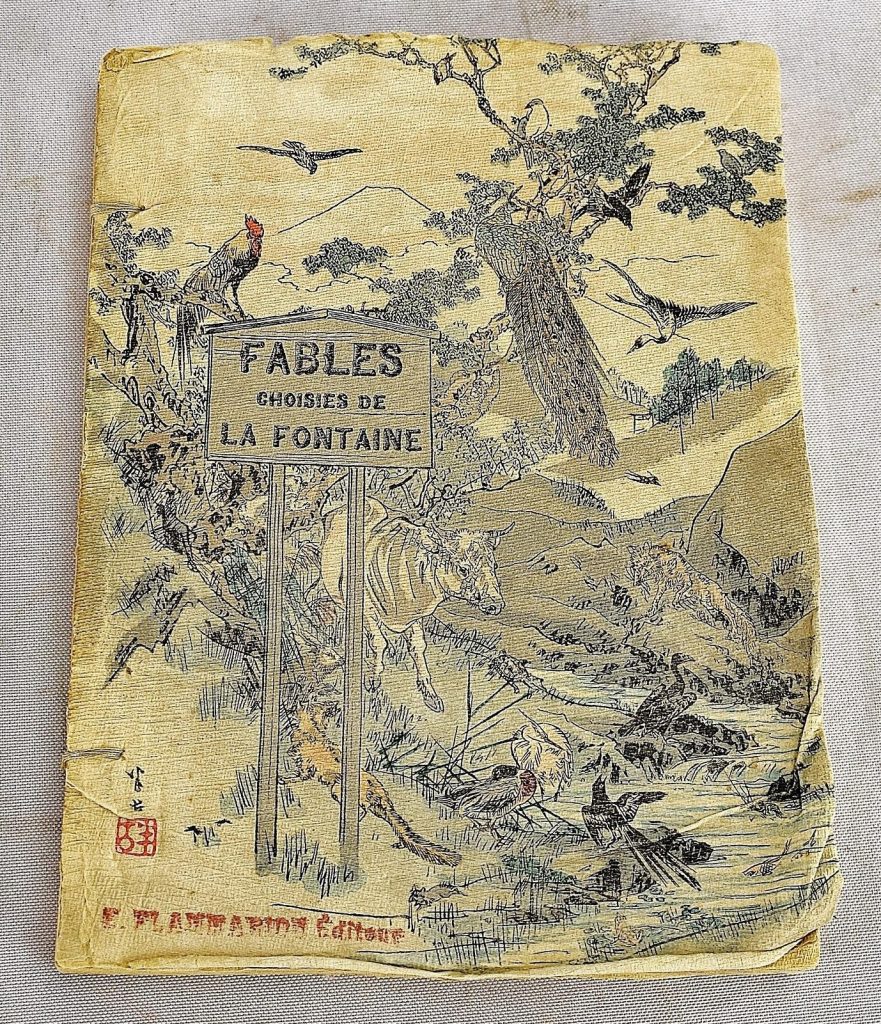
Later surprises included finding not just books but also many objects presenting the fables of Aesop and the second-best known creator of fables, the 17th-century French poet Jean de La Fontaine. I love flea markets and garage sales! The Carlson Fable Collection at Creighton now has more than 8,000 objects illustrating fables, from buttons to broadsides, cards to carvings, menus to masks.

I also love used bookshops and bookfairs. I keep finding artful books with their creative stories, morals and illustrations. The collection now includes more than 11,000 books in 82 languages. We Jesuits are travelers, and I have found Aesop wherever I have traveled — Thailand, Nigeria, Hong Kong, Germany, Morocco — though my favorite is Paris since the French keep on illustrating their beloved La Fontaine. I was fortunate to get back to Paris a year ago with a crew of Creighton colleagues who had the happy task of filming me finding more fable books! Bookdealers there understood my obsession with fables and welcomed our crew.
The collection now includes several important editions from the 1500s and most of the important editions from the 1600s on. One extremely rare volume escaped the London Fire of 1666. Another from France in 1939 satirizes Adolph Hitler. It survived then and since in Portugal — until I found it on eBay. The prize of the collection is a complete collection of Marc Chagall’s 102 etchings of La Fontaine’s fables. Unusual objects include a page from an edition of the 1480s, complete collections of cigarette cards from the early 1900s, and a surprising number of pieces from the 1830s by the legendary maker of tableware, Spode. There are some 3,500 cards of various sorts, hundreds of plates, over 50 kinds of buttons and stamps from 28 countries.

The Reinert-Alumni Library at Creighton University houses the collection. I love giving tours. Ask me for one! Part of any of those tours is hearing stories, some known and some new. I generally refrain from adding a moral. Instead, I regularly ask guests what they perceive in a story I have just told. I love bringing people back to stories like “The Grasshopper and the Ant,” “The Fox and the Crow,” “The Boy Who Cried Wolf,” “The Milkmaid and Her Pot of Milk” and “The Fox and the Grapes.”
My favorite fable is “The Miller, His Son, and Their Ass.” Along the way, people criticize whatever this miller and his son do as they bring their ass to market. Who should ride? The miller? His son? Both? Neither? The poor miller tries to please everyone and ends up frustrated. Clever storytellers offer different ways of ending this great story. In some, the ass falls over a bridge and is swept away by a river. In others, the miller decides along the way to do what he wants and to forget about pleasing everyone. In still another version, the miller gets so frustrated with himself that he throws the ass off the bridge!
What then is a fable? I define fable as a “past-tense short narrative inviting a hearer or reader to perceive something about living life.” Almost the only magic in fables is that everyone and everything can speak, including animals, who are among the most frequent actors. By contrast with fairy tales, fables do not invite us into a fantastic world removed from reality. Instead, they challenge us to open our eyes to the reality in front of us. Are we, like the tortoise, forgetting that we are in a race? Are we, like the fox, saying “Sour Grapes,” only badmouthing what we cannot get? Might we be like the crow with a newly found piece of cheese in his beak? Should that crow believe the clever fox praising his beauty and pining to hear his song?

As a young professor, I was once asked about my career goals. My spontaneous answer was playful but also serious: “When I grow up, I want to be a storyteller.” That wish has come true! I offer frequent presentations. Some have been recorded, like several DVD offerings by LEARN25. A supportive team of Creighton colleagues has helped me to produce a booklet, “Engaging Some Great Fables!,” available for $20 from the Archives and Special Collections at Creighton University. Each of the 32 fables there receives my own version of the story, some questions for reflection and a photograph of a surprising object illustrating the story. “A fable a day keeps boredom away!” You know now why the stories there do not have morals.
I do perceive a moral as I reflect over my life story with its surprises. Both Aesop and Jesus contribute to my life in a way that respects both of these storytellers. Jesus’ parables dig deep into our values: Am I like the son who needs to strike out on his own, careless of father and family? Or am I like the grudging brother expecting to be rewarded for hard work? And what of this crazy father who says yes to insulting requests and later runs to embrace the insulter? We do well to let Jesus’ stories dig deep into us and challenge our values. Aesop’s stories operate mostly at a different level closer to the surface of our lives, but they similarly invite us to the kind of reflection dear to followers of Ignatius. Both kinds of stories are wonderfully crafted, deeply human and a joy to listen to. Collecting Aesop has only deepened my listening to his stories and those of Jesus!
Those with questions about fables are invited to contact me at gcarls@creighton.edu. The collection is viewable online at creighton.edu/aesop. Copies of the booklet are available through Archives@Creighton.edu.