
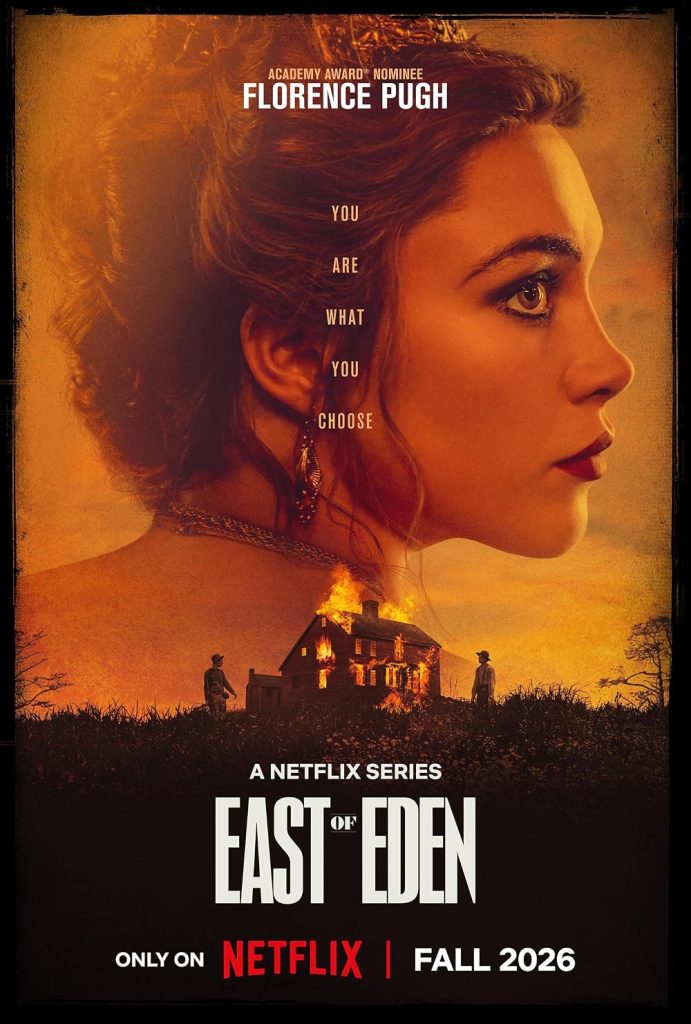

On October 1, Netflix dropped its seven-episode adaptation of John Steinbeck’s 1952 novel “East of Eden.” Generations have passed since the novel was last adapted for film or television. Certainly, the Netflix version conforms to audiences’ expectations of “prestige television.” How closely it comes to serving Steinbeck’s themes of good, evil and free will is something for audiences to consider.
A Novel of Its Time and of All Time
Steinbeck’s novel spans about 70 years, from the U.S. Civil War to the First World War. It tells the story of two families, the Hamiltons and the Trasks, and is set in the Salinas Valley of California. Although not a conventionally religious man, Steinbeck seeks to fuse American history with stories from the Book of Genesis, from the fall of Adam and Eve to the story of Cain and Abel. How have we lost paradise? he seems to ask.
Thou Mayest: The Challenge of Human Freedom
Indeed, “East of Eden” is centered on big moral themes: good and evil, love and sacrifice, being wounded and being healed — often literally. This series does much the same, although not at quite the same depth. The story’s key theme is free will. A large part of the book centers on a discussion of the translation of a passage from the fourth chapter of the Book of Genesis.
This part of Genesis discusses Cain’s anger at God’s acceptance of Abel’s offering of an animal sacrifice and God’s rejection of Cain’s offering of the “fruit of the ground.” Characters discuss how differing translations of the seventh verse of the chapter could yield differing meanings. The King James Version offers a promise of conquering sin; the American Standard Version offers an order to conquer sin.
The characters conclude that the correct translation of the key Hebrew word in the verse, “timshel,” is neither a promise nor a command. Its best translation might be “thou mayest,” conveying both the familiarity of the pronoun “thou” and the freedom of the verb “may.” Thou mayest or thou mayest not conquer sin. We have free will. Cain makes his choice to kill Abel, yet he does not fall completely from God’s grace.
Hence, the idea of “timshel” is at the heart of the story: Thou mayest. The reader and the audience come away with a question as old as the story of Cain and Abel: What do we do with our freedom?
Sons and Brothers
The challenge of freedom is played out by nearly all the series’ characters. The Trask family is represented by two brothers from Connecticut, Adam (played by Christopher Abbott) and Charles (played by Mike Faist). One night, Adam Trask finds a young woman, Cathy Ames (played by Florence Pugh), collapsed on their porch after being brutally beaten. He cares for her, and after she recovers her health, he marries her. But Cathy has a uniquely troubled and criminal backstory of which Adam is unaware, to his eventual detriment.
Cathy’s character in the Steinbeck novel is simply evil. Steinbeck even uses the phrase “bad seed” to describe her. In this version, a dimension of social consideration is added. Cathy is indeed depicted as a villain: she destroys one man’s life, driving him to suicide. As a young adolescent, she burns down her own home and kills her parents. All this is suggested to be a result of early sexual abuse. While she struggles with the limitations faced by women in the late 19th and early 20th centuries, she does so in patently evil ways; she makes bad use of her freedom. However, Florence Pugh’s performance is so subtly nuanced and always fully human that we feel for her.
The Salinas Valley
Eventually, Adam and Cathy leave for the Salinas Valley in California, where they meet Samuel Hamilton (played by Ciarán Hinds), an Irish immigrant and the patriarch of his own large family. An Irishman himself, Ciarán Hinds delivers a magisterial performance as an empathetic and wise character who can be a father figure to the struggling Adam Trask. Christopher Abbott’s performance across the entire series merits praise, as he often carries the bulk of the series’ narrative. He is in every episode and at the center of almost every storyline. He also navigates a difficult character arc, from a troubled young man to a suffering elder.
Adam has twin sons with Cathy, who leaves her family to become a prostitute and then a madam. Adam Trask names his sons Aron (played by Joe Anders) and Caleb (played by Joseph Zada), closely paralleling the biblical Cain and Abel. Trask eventually falls into an abyss of depression and self-loathing, allowing his two young children to be raised by his Chinese American domestic servant, simply named Lee, played masterfully by Hoon Lee. These four characters then play out the story of Cain and Abel in a modern context.
A Tale Told Anew
This is a miniseries built around the expectations of modern streaming audiences, such as quality cinematography, well-honed performances and historical accuracy. It was filmed in New Zealand, with splendid production values that rival those of any feature film or limited series. Great attention is paid to historical detail, down to the type of tobacco grown in Connecticut in the 19th century. The series is shot with exquisite care and beauty.
And careful viewers will see the impact of the Industrial Revolution on the characters’ lives. One cannot help but feel that modern life itself has stripped away the innocence and simplicity of earlier times, echoing the theme suggested by the title. Perhaps we’ve lost something of America’s original Eden through the dramatic changes caused by industrialization, modernization and urbanization. Adam Trask takes his children from the country to the city and buys a car but still struggles to find peace.
New Stories, New Visions
This adaptation also gives a much fuller treatment to the experiences of the caretaker, Lee. His hopes and dreams are more fully explored, as is the way they are dashed by the anti-Chinese bigotry of the time. I find Lee to be the single most interesting character in the series. He is born in the United States and speaks fluent English. Yet he speaks pidgin English with people he does not know, shielding himself from bigotry by pretending that he does not understand. He reads volumes on psychology and other fields, hoping one day to open a bookstore. He becomes the loving heart of the Trask family, even though he has no blood relation to them. Indeed, Hoon Lee’s performance in the role speaks to Steinbeck’s themes of familial love, betrayal and finally acceptance. His stoic dignity in the face of prejudice is powerful.
However, it would be a grave mistake to assume this is a “family-friendly” adaptation of the classic novel. Every episode has at least one scene set in a brothel. Many of the episodes contain graphic (and, to my mind, gratuitous) sex scenes, although Steinbeck does not shy away from frank discussion of prostitution in the book either. Hence, the true nightmare of the life of a woman lost in the sex trade is fully depicted in the miniseries. In fact, the series is deeply aware of its moral concerns. Yet perhaps it does not ultimately explore the challenge of being both free and good. In contrast, Steinbeck’s message was clear: human freedom is the challenge that gives our lives meaning. Thou mayest.