
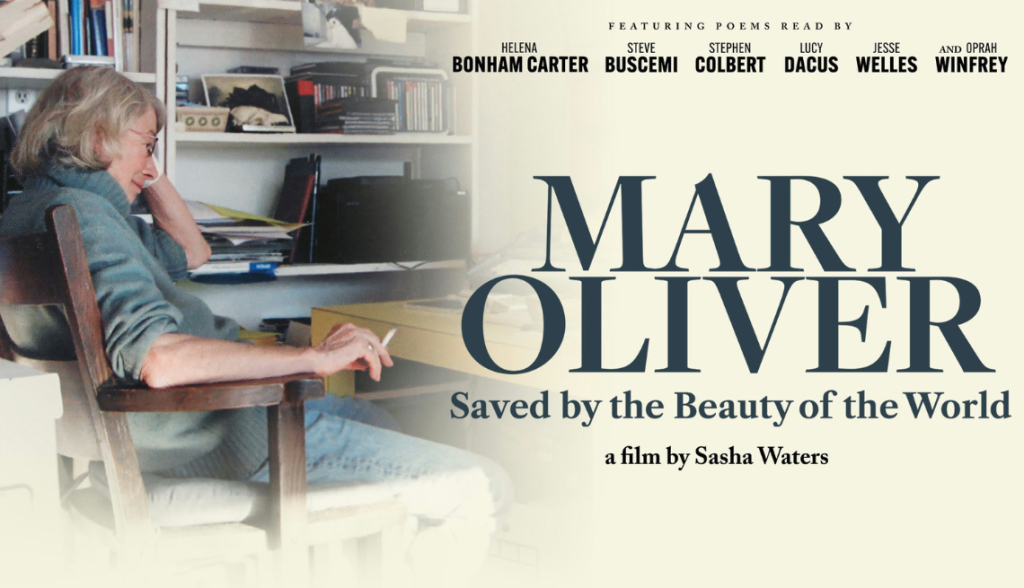

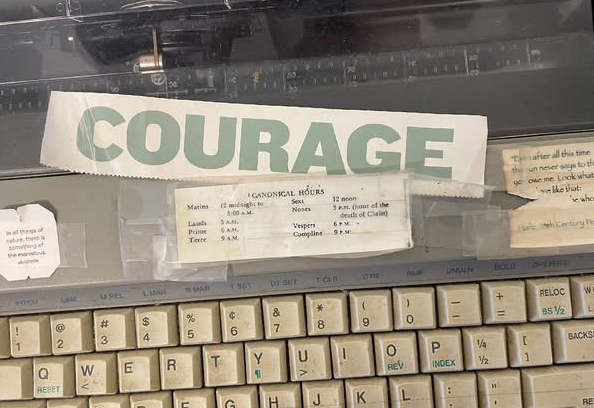
The poet Mary Oliver kept a schedule of the canonical hours of prayer taped to her electric typewriter: matins, lauds, prime, terce, sext, nones, vespers and compline. Although she was not a churchgoer, generations of readers have found spiritual solace in her explorations of prayer and the natural world, often so intertwined that it is difficult to find the end point of one and the starting point of the other. A new documentary, “Mary Oliver: Saved by the Beauty of the World” (dir. Sasha Waters, 2026), shines a fresh and intimate light on the life and work of one of our most gifted and most private secular saints.
Featuring never-before-seen photographs and images of Oliver’s notebooks, the documentary begins with her childhood, which was difficult, marred by abuse and fear. Fleeing this danger, Oliver found refuge in the woods near her Ohio home. But for those of us who hold an image of a poet propelled entirely by nature, Waters’ documentary provides a corrective. From a young age, Oliver says, she loved both the natural world and dead poets.
When asked who she reads, Oliver responds, “Whitman and Whitman and Whitman.” A photograph from her childhood shows her peering through binoculars, and this is as apt an image of her as we are likely to find. Oliver looked intently at the world around her, but also at the world within her, finding in the poetic tradition and in her own work a perfect chapel for the marriage of the two.
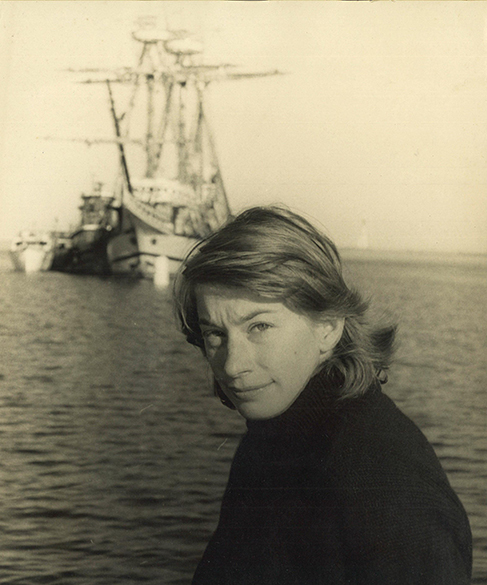
As she settled into her adult life and into a 40-year partnership with the photographer Molly Malone Cook in Provincetown, Massachusetts, Oliver recreated the canonical hours in her own work, keeping to a strict discipline of exploring her surroundings and writing along the way; she would even stash pencils in the hollows of trees along her usual route just in case she forgot to bring one from home. From this thin sketch of her creative life and her prolific poetic output, it’s easy to imagine Oliver’s writerly practice as mystical and ethereal; one might picture her hovering like a saint in ecstasy several feet above the ground.
It’s in rectifying this impression that Waters’ documentary finds its greatest strength: filling in the details of a poet who was as deeply human as she was divinely inspired. Oliver was in her 40s before she had any measurable success, and she and Cook lived very close to the bone, with Oliver working odd jobs to make ends meet. She was not always scribbling in a notebook — she was also working as a secretary and a typist, constantly sending her poems out to magazines and newspapers, monitoring her many rejections, and keeping a close watch on her meager income.
The filmmaker John Waters, a close friend of the couple, offers other specifics likely to be elided by those writing hagiographies of the poet: She smoked heavily, she harvested turtle eggs from the beach and ate them, and no one, with the occasional exception of Cook, could even think of telling her what to do. Oliver might not have made it a practice of revealing these details of her life, but I was grateful for the vibrant color they added to what was a black-and-white portrait of the poet in my mind. It was both heartening and moving to see the hovering feet touch the ground.
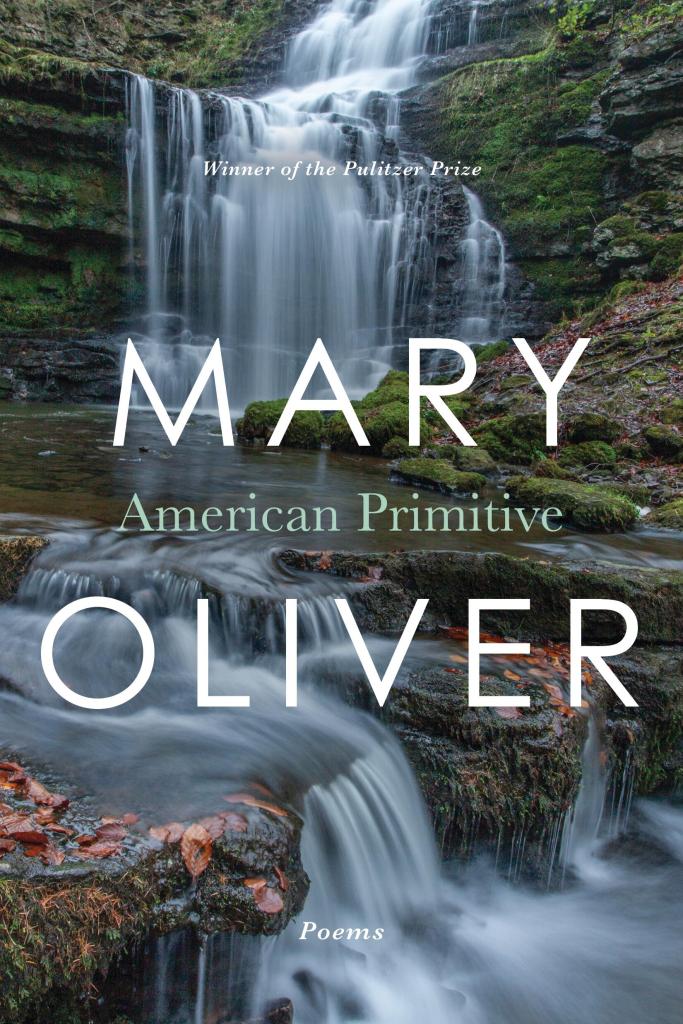
Mary Oliver finally got her big break after Joyce Carol Oates wrote a positive review of her collection “The Night Traveler” in 1978. The Pulitzer Prize followed in 1984, and the National Book Award in 1992. As dedicated in times of feast as she had been in famine, Oliver kept to her discipline. She insisted that looking at the world was the most important part of her life, fueled by her incredibly focused attention. Nonetheless, she did not want to be dismissed as a “nature poet”; she had more to say.
It was precisely because of that more that so many of us understood reading her work as a form of prayer, or at least a warm invitation into dialogue with mystery. “I think you have to be in the world to understand what the spiritual is about,” Oliver said. “And you have to be spiritual in order to really be able to accept what the world is about.” In engaging with the Christian tradition, so many of us who have become too familiar with the landscape to apprehend its delights sorely needed the fresh binoculars that Mary Oliver offered us. She gave us permission to understand prayer and the human experience from a different vantage point, one that was both removed from Christian practice and also deeply immersed in it.
As she became more beloved as a public figure, though, Oliver experienced the shifting sands of public and professional opinion: the more popular her poetry became, the less it was taken seriously by critics. Reviews became more negative, and the poetry establishment was not welcoming to her. Although these slights must have dismayed her, she did not let them deter her.
In her essay “Of Power and Time” in the collection “Upstream” (2016), Oliver describes her fierce dedication to the creative act, come what may. “It is six a.m., and I am working. I am absent-minded, reckless, heedless of social obligations. … The poem gets written. I have wrestled with the angel and I am stained with light and I have no shame. Neither do I have guilt. … My loyalty is to the inner vision, wherever and howsoever it may arrive.”
Oliver’s decades-long wrestling match with the angel left her so illuminated that the stain of light spread out to all of us as well, like a sunrise stretching over a wide horizon. Her work formed a new liturgy for all of us who seek the divine in the world around us and the world within us.
Just above the canonical hours of the day taped to her typewriter was another piece of paper, this one emblazoned with huge bold letters spelling out one word: courage. Mary Oliver offered us hers. And even after her death, I can still feel her encouraging us, in every word, in every stanza, to excavate our own.