


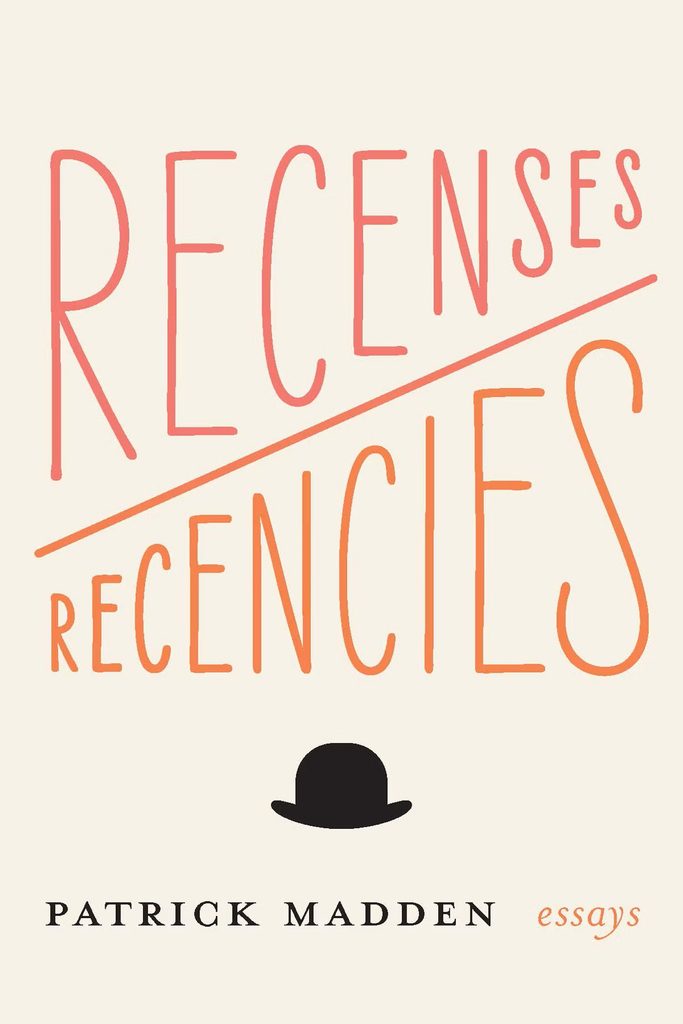
Author’s Note: I have long loved the kinds of essays that meander to surprising connections. As Robert Frost assured: “No surprise for the writer, no surprise for the reader.” So I set out to write a number of essays all beginning with the phrase “I have just …” in order to short circuit my narrative impulses and force my mind outward into associative thinking. As this particular essay notes, it began with my overhearing a bit of conversation in a parking lot. Because I had no other context, I was confronted with how much I (we) have to assume when interpreting language. I had a lot of fun slipping sideways to places I had not intended or imagined.
I have just overheard two people talking as they breezed past me in the supermarket parking lot. “No one gets an ultrasound at seven months,” said one, an older woman, perhaps the other woman’s mother. “The only reason I did was I didn’t feel Tyler moving, and I was scared.” And then they were gone, out of earshot, and I was left placing the groceries in the trunk, thinking. I return to the moment now, wondering about how little and how much we convey through language, how our communication is only ever partial communion, how it’s always approximate, asymptotic. Also how in other places and times, I might scoff at the unsophisticated adjective scared, might preach its insufficiency, its universality-to-the-point-of-meaninglessness, but here I allow myself to be moved, which adjective, moved, is really no better, no clearer and no vivider, than scared, and thus we see that the pedant readily forgives his own infelicities and lazinesses while . . .
But the thing I took with me, and the thing that drives my essaying today, was a kind of hope centered in the proper name, Tyler, a person I’ll never meet and about whom I have essentially no information but this: I assume, given his mother’s invocation, that he exists, that he was born and named, and thus her fears at seven months did not result in the horrible outcome that scared her. This story has a happy ending, I presume.
[Yes, I know that my presumption is . . . presumptuous, and endings are naught but continuances, really, but let us pause briefly and allow this interpretation, at least for a beat.]
Of course, to believe in such a thing, or even to make any kind of meaning of the overheard statement, I must assume so much. I know that there’s in fact no assurance of a happy ending, either in the past or in the future. It’s possible that someone might name a stillborn child, or a child born but taken soon after. And who’s to say that Tyler is this woman’s son? Could the name refer to a daughter? (As if the universe wants to participate in my essay, to nudge me further away from my certainties, I am currently teaching a young woman named Tyler, the first in my experience.) Could the woman be a doctor at a checkup for another woman? And ultrasounds are common not only for fetus monitoring, though, of course, given other clues, I’m confident in that interpretation here. Within the statement I overheard, there’s assumption and ambiguity, too. Certainly some people get ultrasounds at seven months, and some of these procedures are routine.
And what of this observation: The speaker did not look to have had a baby recently. I could be wrong, again, but the thought occurs: If the ultrasound was not recent, what recent event called it to mind? Why was she sharing it with her companion? Was the other woman experiencing difficulties with a pregnancy (she did not look to be late in a pregnancy)? Or was a mutual friend? Perhaps the supposed good news about Tyler portended bad news about someone else. One does not simply walk into Smith’s Food and Drug casually commenting on past ultrasounds.
Some of my audience will have noted just above my detoury (desultory?) invocation of a line from The Lord of the Rings (the movie, not the book), spoken by Boromir about the difficulty of getting to Mordor, which statement became a popular meme and thus has been put to all sorts of varied meanings (usually changing the verb [one does not simply saunter, taxi, rock into Mordor], sometimes changing the entire second phrase [one does not simply hit the snooze button once, take something off the internet, skim Derrida], most or all of them lent humor by the slight distance from their source). I’m still unconvinced by my choice of phrase, which was inspired, I believe, simply by being alive here and now and faintly connected to such internet inanities. If you’re reading this paragraph, we can assume that for some reason or other (likely laziness), I’ve neglected to revise it out. At the very least, we can understand it as yet another attempt to reach across time and space to connect, to wink at something we both presumably know, because we are both alive here and now, as all people have been, always—even, we still hope, Tyler.
Just think of the tremendous associative work, the vast interconnected contexts we must bring even to the simplest, directest of commands. For example:
“Just do the dishes.”
Said just now in unwarranted exasperation to my children, who’d be content to let them pile up for days (the dishes, that is) and whose primary concern, it seems, is to escape any and all unpleasantness associated with “work,” which attitude wears me down for myriad Martha-like reasons, though I understand them, too (the reasons, the children), and thus my choice of unwarranted above. To catch my meaning, what must they understand of do (in this case, rinse and place in the dishwasher in an orderly fashion that makes sense given the spacings of the rubber-coated metal pegs)? Or of the dishes (not all of them, not the ones in the cupboard, just the ones we used for our recent meal)? Or, most mysterious, just, with its scattered variant meanings, most of which we know intuitively, having been absorbed in, and by, this language since birth?
[Or so we let ourselves believe. Heather Christle’s terrific pun of an observation reminds us just how fluid and uncontrolled our language is: “How horrible it is to hear someone say, ‘She’s just tired!’ Tired, yes, certainly, but just? There is nothing just about it.”]
Or, to move far away with just a single word shift,
“Just do the breeze,”
as my friend Kim Johnson once wrote in phonetic translation of the poem “wiersz dla marty podgórnik (ekstra-dykcja)” by Marcin Jagodzinski, which, if I were to hear it read aloud in its original Polish, would suggest nothing to me, or, at best, would strike me as something akin to what Johnson has written in her “Failed Psalm”—a string of half-familiar sounds signifying something I’m sure wasn’t intended. If we were to apply a more traditional translation (for instance, Frank L. Vigoda’s), it might mean (in part):
it’s fine. I watch and start (it’s
fine) to talk. the great instead is coming,
it is very scary . . .
(Yes, I have selected exactly these lines from the middle of the poem and ended them on a word [slightly transformed] that we remember from the overheard lines that began this essay, but I have also begun my quotation exactly where “just do the breeze” appears, phonetically, as “juz dobrze,” and I would have you know that the scary coincidence was unintended, discovered serendipitously, perhaps [I suppose] as one more universe-reproach of my pedantic prohibition against simple adjectives.)
The poem, like the exchange in the parking lot, is an overheard conversation, a snippet of interaction between two people I have never met, in this case Marcin Jagodzinski and Marta Podgórnik, whom he names as his addressee in the title. Beyond the poem’s sixty-three words (in Polish; seventy-two in English), I have no access to their communications, no context for this missive, no follow-up. Then again, I am invited to overhear, as are you and anyone who encounters the poem, but my understanding of “the great instead” that arrives (is arriving) at the poem’s opening is nothing but abstraction, surely far from the meaning Jagodzinski intended for Podgórnik to get. Understanding and accepting this, we might, as we continue to explore felicitous resonances, note Jagodzinski’s assertion that “everything is made-believe (the entire dictionary),” which rhymes nicely with this little essay’s explorations within and utilizing language for the purpose of exploding language, or exploding language’s reductivist tendencies, or perhaps the reductivist tendencies of language’s users, who are us.
[Renee Gladman gloriously and continuously explodes reductivist language in her Calamities, including adding yet one more definition of to do to the hundreds of shades we understand instinctively, innately, almost: “That city was one of the places I’d been and simultaneously was one of the things I did while I was there. I did the place I was in, because the place was entirely itself, so to be there was to do it.”]
May we pause here a moment to return to and admire the vast distance between “Just do the dishes” and “Just do the breeze”? May we feel the glory of language as we note how not only the last, different word of the latter phrase inflects (genuflects) toward new meaning, but the other words do so as well, including, most especially, do, which clearly does not ask us to rinse plates and load (the breeze) I was seeing this as a kind of editorial insertion, thus the square brackets; maybe we could use italics instead of punctuation? into the dishwasher? But let’s back up. What, first of all, is “the breeze”? Aside, of course, from the airy thing we know well as “the breeze.” In this new context, following that utilitarian-to-the-point-of-invisible catchall verb, what is “the breeze”? And how, ever, might we do it? We are left to ponder, in wonder (the word suggests itself primarily if not purely on melodic grounds), what “doing the breeze” might mean. A dance move? A mimicry? A shucking of responsibilities? A pause exactly like the one we are enacting now (my now a bit earlier than your now, of course, but each remarkably [unremarkably] now [as always])? Are we here and now obeying/complying with Johnson’s exhortation? Are we doing the breeze in this very moment!?
Then again, in an earlier time that was also now, just a century or so back among my ancestors, just two successful generational births before mine, Frances Kalinski, or Collinski as it was sometimes written (in seeming phonetic translation to a spelling familiar to the Irish-descended people she lived among in Wisconsin [including her husband, Daniel Madden]), would have felt Jagodzinski’s poem deeply, perhaps more deeply than any words in English, the language she adopted in adolescence, so that the Polish that shaped her earliest thinking became a private language, both isolating and freeing, a soil from which to grow into herself and give to others, a refreshing wind to waft her thoughts, a parking lot she could traverse alone, mumbling to herself, without fear of eavesdroppers overhearing and misunderstanding.
Excerpt from “Recenses/Recencies” by Patrick Madden by permission of the University of Nebraska Press. © 2026 by Patrick Madden. Available wherever books are sold or from the University of Nebraska Press 800.848.6224 and at nebraskapress.unl.edu.