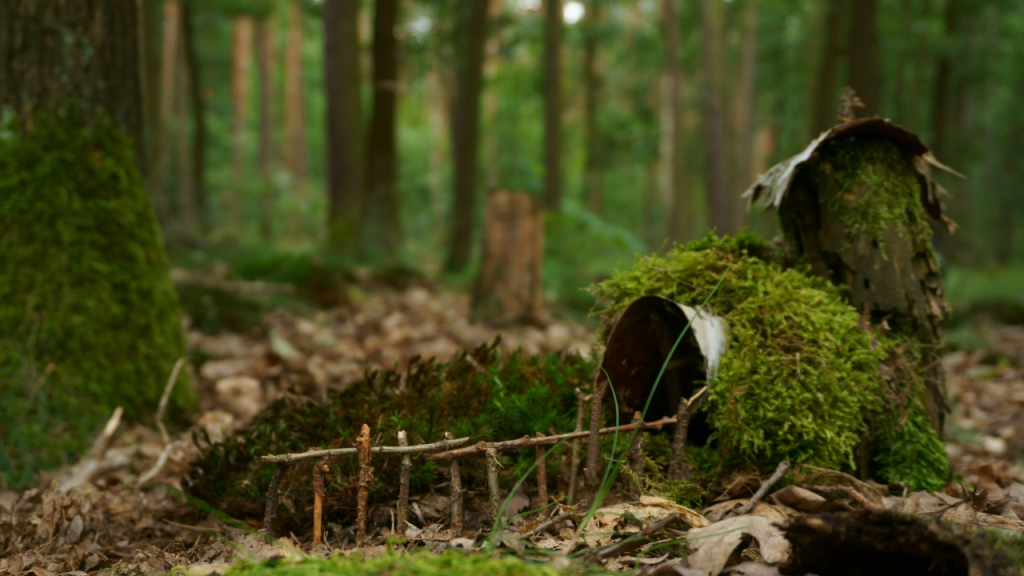
Wind and rain have battered the tiny painted structures. The fairy houses stand nestled on a rock in the shadow of a tall crepe myrtle from which a flurry of pink petals have fallen. They’re dead now — brown, decaying, clumpy. The little structures themselves are faded: Bright reds have become pale pinks; highlight yellows have turned nearly white. The inhabitants of this small landscape-bound community are in no better shape. The gnomes have been toppled; the fairies are on their sides. Even the dragon, tasked with protecting the small village, has succumbed to the wind. The great pink creature faces a completely arbitrary direction, offering hardly any protection.
“Will you help me fix it?” My eldest daughter stands with her hands on her hips, curls tumbling about her shoulders. “We can’t leave the fairy garden like that.”
I purse my lips, rub the back of my neck. I have other things to do. These are her toys after all.
“You can do it,” I say.
“I can’t,” she insists. “I need your help. The fairies will never come if the fairy garden looks like that.”
She’s got a point. “Fine. Show me what you need.”
For the next twenty minutes, I squat alongside Elianna, carefully taking each of the fairy garden pieces in one hand and rinsing them off with the hose I hold in the other. There are too many spider webs, Elianna insists. We need to get rid of those. Camira — my youngest — concurs.
“Aren’t spiders good for a fairy garden?” I ask. “Same size and all, right?”
I’m a fool. Spiders are not good for a fairy garden. No speck of web nor wayward piece of dirt will be tolerated. I suppose the fairies could get stuck in the web, eaten by the spider. Perhaps I’m not thinking this all the way through.
I wash off each individual piece — the little people, the little homes, the little chairs and table — and then turn my hose on the rock.
“You missed some bird poop,” Elianna says, pointing. I say she can hose the rock off herself if she’s going to be so picky.
“I think we need a second rock,” she says instead, once the first is clear and clean. “The fairies need more room.”
I can’t say I disagree. I haul another flat piece of stone over and lay it next to the first, still nestled in the shadow of the crepe myrtle. “We can use this bridge to connect the two,” I say, proffering one of the now-clean fairy garden pieces. Elianna nods. Like that was the most obvious statement in the world. We proceed to rebuild the fairy garden, placing each denizen of the village and miniature structure in its proper location.
When the work is done, we stand back and admire this piece of fairyland that sits snuggly in our front yard.
“The fairies are going to like this,” Elianna says with a grin. I nod, smile back. I believe they will. And I still have time to mow the lawn. But I’m glad that I’ve taken the time to rebuild this little fairy tale village. And why?
This was more than a half-decent attempt at parenting. I’ve replied to my kids’ requests for crafts and games with a confident “No” on plenty of occasions. After all, how else would the lawn ever get mowed?
But this was different. The fairy garden isn’t just a game, though it is that and more. It isn’t just an outdoor craft, though art and color abound. Sitting with my daughters in the mud and the mulch, propping up fading fairy tale creatures was something else entirely. This was an affirmation of imagination, the participation in its upkeep and refueling. This was a near-mystical experience, a huddling together at a gateway that opens not simply into our front yard but into the land of Faerie, a land of elves and wizards, of talking trees and wise wolves. This was a father and his children daring to partake in something beyond our knowing, beyond the seen and the understood, something that points to a world that transcends the one we inhabit, a world of myth and magic and unbound possibility.
In the humdrum preparation of a fairy garden and the hope-filled wondering that such magical creatures might pay our home a visit, we dared imagine that which we’ve never truly seen. We prepared a space for those unknown visitors, and in so doing tilled the soil of our imagination to look for and expect not fairies but God’s own self.
Eric A. Clayton
This was a near religious experience. As a Catholic who is deeply formed by a Catholic imagination — which, in the words of Fr. Andrew Greeley, “sees created reality as a ‘sacrament,’ that is, a revelation of the presence of God” — I am always ready and eager to see in the ordinary materials of our days something more, something other, something mystical. [i]
We did not bless ourselves or recite well-worn prayers. We held no rosary beads and found no holy water. And yet, we still oriented our minds and hearts in the direction of mystery. In the humble offering of hand-painted figurines and dying flower petals, we once more affirmed that creation is vast and beyond our wildest imaginings, that it is dripping with the sacred. In the humdrum preparation of a fairy garden and the hope-filled wondering that such magical creatures might pay our home a visit, we dared imagine that which we’ve never truly seen. We prepared a space for those unknown visitors, and in so doing tilled the soil of our imagination to look for and expect not fairies but God’s own self.
This is the foundation of a sacramental imagination, one that sees the ordinary raw material of our days as graced, as pulsing with potential, as pointing beyond the known and piercing the veil into the sacred. I desperately want this for my daughters. I want it for myself, too. I want to nourish it, share it, watch it grow and flourish. For me, this sort of imagination is fed in the lands of Middle-Earth, Westeros and Narnia, around a game table cluttered with cards and dice and handwritten notes, through the wielding of swords with names and the casting of spells meant to elevate the good and the beautiful.
This sort of imagination makes room for a God that is far greater than we know, far beyond what our human minds can conjure, and yet intimately present in our mundane, nitty-gritty lives. This sort of imagination seeks after this wild and mysterious God, looking for clues, for breadcrumbs, for hidden thresholds across which God’s Spirit calls, invites, whispers. This sort of imagination is humbly offered to the Creator who wishes to use the raw material of our curiosities, wonderings, and awe to make manifest something fantastical.
Consider how God is at work in your imagination. Is the Holy Spirit speaking to you through the stories you love, through the mysteries you encounter, through the natural world itself?
[i] Andrew Greeley, The Catholic Imagination (University of California Press, 2001), 1