


“Forming a Practice of Hope” is a monthly guide that will be published throughout the 2025 Jubilee Year in the Catholic Church. It is designed to spark a personal spiritual practice that is flexible and doable and is meant to be a road map that examines dynamics of the creative life and spiritual life. Read the other monthly guides here.
Hope is not something we rely on when times are good. It seems to spring from the crises in our lives, when things invade “our lives as we would like them to be,” and calls us back to imagine anew “the best that things can possibly be” in the midst of a crisis. It is about possibility. God often helps us with this by showing us a possibility in circumstances that we would think are impossible.
We have to remember that Christ was born into the world in a time of crisis. Of all the times he could be born, he chose a time when occupying forces in the country of his earthly parents demanded a census to tax the people. We know that it was in this context that the greatness of God’s love was revealed; that God wanted not only to be a companion to us, but most of all God wanted to be a companion in our struggles. Perhaps this is why the Christmas story is so hopeful and why we find a surprising amount of good will in the world when we make room to celebrate it deeply.
Ignatius’ meditation on the Incarnation has us imagine the Trinity looking over the whole face of the world in all its complexity and conversing about how to save humanity. God responded with compassion and action.
Lately with all that is going on in the world, I have been hearing folks saying, “I don’t want to think about that,” “I don’t feel like it,” or “I don’t have the energy.” These are precisely the times when we need hope the most, even if we don’t feel like it. Ignatius’ meditation on the Incarnation has us imagine the Trinity looking over the whole face of the world in all its complexity and conversing about how to save humanity. God responded with compassion and action.
As early as 2022, Pope Francis was planning this Jubilee of Hope for the church and for the world. Still reeling from the effects of the worldwide pandemic, he wrote to the president of the Pontifical Council for the Promotion of the New Evangelization, Rino Fisichella:
“We must fan the flame of hope that has been given us, and help everyone to gain new strength and certainty by looking to the future with an open spirit, a trusting heart and far-sighted vision. The forthcoming Jubilee can contribute greatly to restoring a climate of hope and trust as a prelude to the renewal and rebirth that we so urgently desire; that is why I have chosen as the motto of the Jubilee, Pilgrims of Hope. This will indeed be the case if we are capable of recovering a sense of universal fraternity and refuse to turn a blind eye to the tragedy of rampant poverty that prevents millions of men, women, young people and children from living in a manner worthy of our human dignity. Here I think in particular of the many refugees forced to abandon their native lands. May the voices of the poor be heard throughout this time of preparation for the Jubilee, which is meant to restore access to the fruits of the earth to everyone.”
In these last few weeks of this Jubilee year, we are invited to hold fast to hope and refocus our sight on how, amidst all the problems, there are people who continue to do what is right and just and good.
Life story:
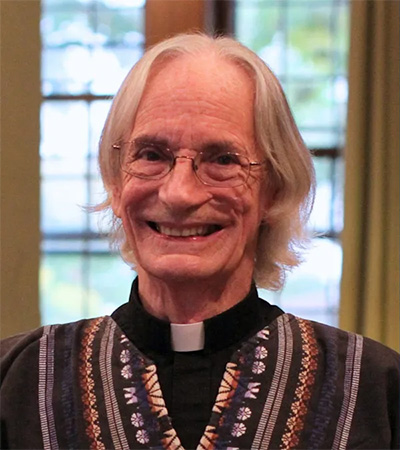
On one of my many visits to teatro la fragua in Honduras, the company was rehearsing their Christmas play “La Esperanza del Principio” (The Hope of the Beginning.) Director Jack Warner, SJ, formed this company of actors over the course of many years of work. Beginning as a way to involve young people in the mountain village of Olanchito, the group eventually became the country’s only year-round full-time theatre company, with a lot of hard work from Jack and his actors, and with the generous support of people all over the world who believed in its mission.
Jack put together biblical stories, texts from pastorellas (Latin American Christmas plays), and even some translations of contemporary writers such as Jean-Claude van Itallie. One of the most poignant juxtapositions began with a section of van Itallie’s play “The Serpent.” It was the Cain and Abel story. It exemplified the tragic introduction of violence into the world with Cain killing his brother Abel, and the shock of the finality of an act of anger and jealousy that could not be undone by Cain himself.
The voice of God, boomed from the whole company “Cain, where is your brother?” The reply of course was “Am I my brother’s keeper?” But God asked a second time … and a third time … and after the third: “Where is your brother?” The answer came from the company singing the genealogy of Jesus and dancing exuberantly. It was shocking, wonderful theatre. Simply by juxtaposing these two moments, it was as if the play were saying, “Here is your brother, Jesus is your brother, and he will undo the act which you could not undo yourself.” The cause of our hope sprung from this desire of God to give us a new beginning in Christ.
Work story:
For the past few months, I have been working giving online workshops with actors in Ukraine who are part of NASHi Experimental Theatre Club, founded by a former student of mine, Romana Soutus. They are preparing for a festival that will take place in Kyiv at the end of April of the new year. Often our work sessions are interrupted for various reasons. The power is cut and they need to switch to a generator. The air raid announcement comes in, and the actors need to decide if it is safe to continue rehearsal. In the midst of all of these things, these young actors dive into the work and find excitement, inspiration and sometimes even transformation.
In our session on December 6, 2025, the feast of St. Nicholas, we expanded our scheduled mid-rehearsal break so that the actors could have a gift exchange. They sang songs, recited poems that they had written about each person, and spoke words of appreciation for each other. Their gifts were simple: a book, a box of tea, art supplies, a journal. Yet they were given with such joy. I asked them to sing a Nicholas “Kolyada” one of the songs sung on that are sung on that day. The song they sung was “Ой хто, хто Миколая любить”:
“O let the one who loves St. Nicholas
For his sake be a helper at all times, O Saint Nicholas!”
After one verse of this song, they cheered and embraced and we went on with rehearsal. But this song has more verses:
“O look upon our native country upon her cruel destruction.
O people, we beseech thee beg from God good fortune O Saint Nicholas!
A good hope we ask for our country-May she rise, up now from ruins,
May a good fortune greet her in glory and freedom let her shine out, O Saint Nicholas!”
This is a very old song and yet it feels as if it were written for these current times. Hope is a way of life for these people, despite a long history of crises that were not of their own making. Their hopeful spirit is radiant and inspires me deeply.
Further investigation:
Suggestions:

- Play your favorite Christmas carol, listen to it for where you find hope, and find out its history.
- Write “feel like it” or another thought that might help you commit to your practice on a Post-it note and put is somewhere that you will see several times over the course of a day.
- Think about the most thoughtful or most meaningful gift you’ve received in your life and ask, “What made it meaningful?” Write or journal about it.
- Re-read “Spes non Confundit” which introduced the Jubilee Year. (See first month of this series.)
- Do an Examen of Hope: Focus on what helps you feel hopeful and what pulls you into the opposite of hope.
- Make list of “what I CAN do” and pick something each day to do.
- Go to Google Maps and follow the route from Nazareth to Bethlehem. Pick a point on the road and switch to street view, imagining yourself walking this journey with Mary and Joseph.
- Find an image, a Christmas card that you received, or a special message that made you feel particularly hopeful and stay with it for a while.