

“Imagining the Gospel Scene” is a series from the Jesuit Media Lab. On occasional Sundays throughout this liturgical year, creators in the JML community will respond to the day’s Gospel passage through the practice of Ignatian contemplation, or what is sometimes called “imaginative prayer.”
In his Spiritual Exercises, St. Ignatius of Loyola invites participants to place ourselves in Gospel scenes using the imagination, relying on our senses to develop a distinctive, personal perspective on a given story — and thereby getting to know Christ better. After praying with the Gospel using their imaginations, our contributors will create a piece of art flowing from their experience — a painting, poem, short story, song, photograph or work in another medium.
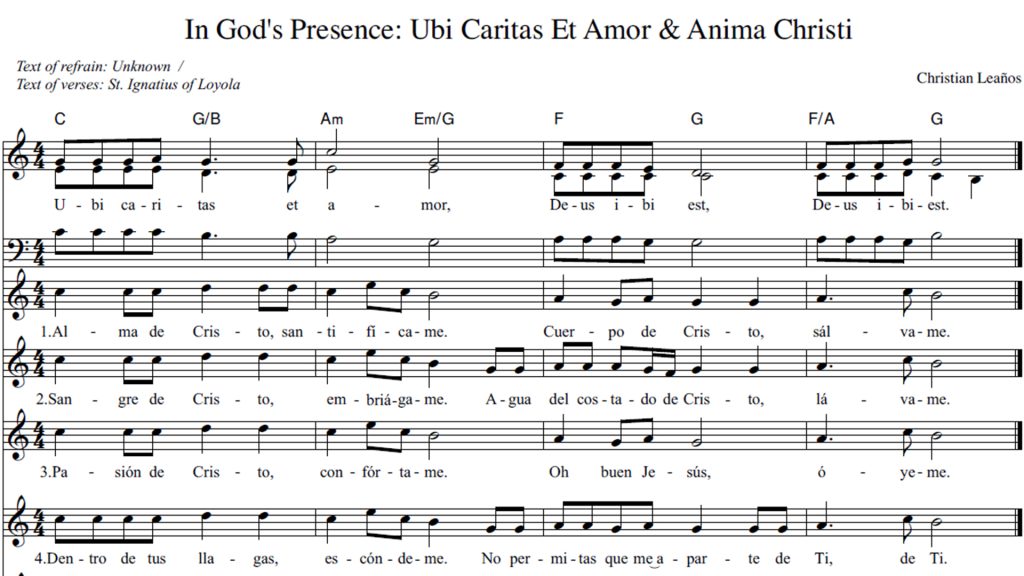
Today’s installment is by Christian Leaños, who wrote a score, “In God’s Presence,” and reflects on it below.
Twentieth Sunday in Ordinary Time: August 18, 2024
John 6:51-58
As we gather to reflect on this Sunday’s Gospel, I am drawn to the profound mystery of the Eucharist, where Jesus proclaims, “I am the living bread that came down from heaven; whoever eats this bread will live forever.” In these powerful words, Christ reveals the extraordinary gift of himself, given for the life of the world.
To deepen our meditation, I composed a song titled “In God’s Presence: Ubi Caritas et Amor & Anima Christi.” This song brings together two cherished texts that beautifully complement each other and reflect the heart of Jesuit spirituality. “Ubi caritas et amor” reminds us that where charity and love are found, God is truly present. This divine love is fully realized in the Eucharist, where Christ gives himself to us — not just as a symbol, but in the real presence of his body and blood.
Complementing this, the “Anima Christi” prayer expresses our deep longing for unity with Christ in every aspect of our being. It’s a prayer that flows naturally from the Eucharist, asking, “Soul of Christ, sanctify me; Body of Christ, save me.” In these words, we echo our desire to be transformed by Christ’s love, especially as we receive him in the Eucharist.
Together, these texts invite us into a profound communion with Jesus. The Eucharist is more than a symbol; it is Christ himself dwelling among us, nourishing not just our bodies but our souls, granting us eternal life. As we partake in this sacred meal, we are called to become what we receive — living bread for the world, sharing Christ’s presence in our daily lives, and reflecting his love and mercy to all we encounter.
As we meditate on “In God’s Presence: Ubi Caritas et Amor & Anima Christi,” I invite you to open your hearts to this divine mystery. Let Christ dwell within you, transforming you into his image, and filling you with the life that only he can give. Remember that in the Eucharist, we are united with Christ and with one another in the deepest possible way — a unity that transcends time and space, binding us together as one body in him, the Bread of Life.