
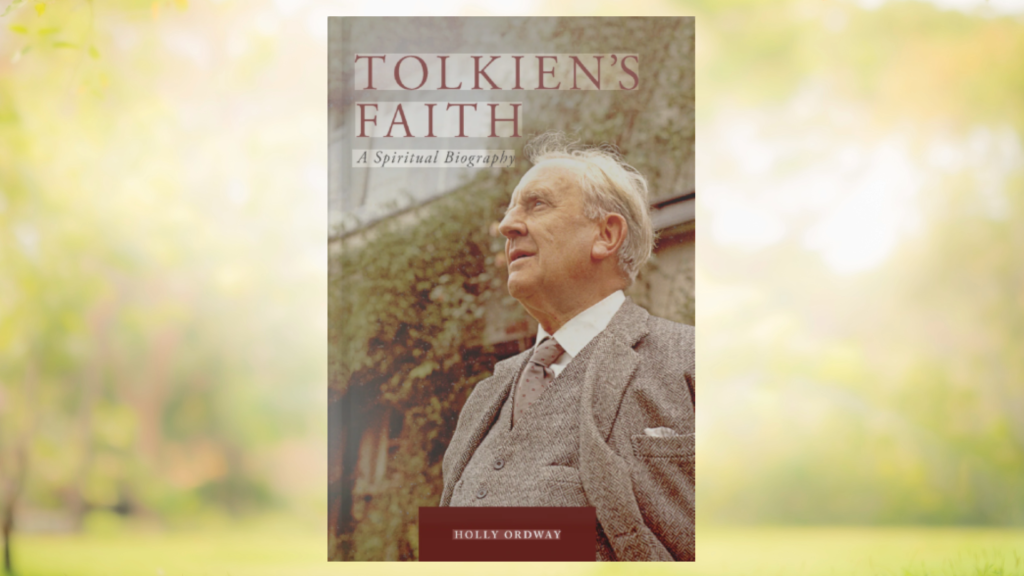

I didn’t read “Tolkien’s Faith” because I’ve been a lifelong fan of “The Lord of the Rings.” The last time I read the trilogy I was 13 and my most frequent exposure to Middle-earth these days comes from listening to Led Zeppelin’s “Ramble On.” No, I picked up Holly Ordway’s study of how Tolkien lived his Catholicism because of Eric Clayton.
A couple of years ago, I read this quote in one of Eric’s columns for “Now Discern This:”
“A Catholic imagination is one tasked with reenchanting the world. We train our eyes to see the ordinary dripping with grace, the sacred hiding behind every corner. We weave stories that reveal a God intimately connected to and dwelling within the world. Such an imagination truly does see God present in all things, delighting in us, laboring with and through us.”
I lingered over the phrase “Catholic imagination.” I’m a Catholic and an artist. What does my Catholic imagination look like? I didn’t know the answer, but I was determined to find out. When I came across Ordway’s book, I felt a surge of hope. Surely Tolkien could show me something of what I was searching for.
In “Tolkien’s Faith,” Ordway writes from long familiarity with both Tolkien’s work and the Catholic tradition that shaped it. As a scholar, she’s researched, written and taught about his work for over 30 years. While living in England, she befriended his daughter, Priscilla, and attended the same church he did. I also felt a kinship with her background as I, like her, am a Catholic convert.
As I explored the book, I became aware that Tolkien scholarship is a formidable area of study. While there have been other books that address his Catholic faith in some fashion, Ordway maintains that prior to hers, there has been “no full biographical treatment that presents Tolkien’s faith in detail.” While I can’t evaluate that statement, I can say that I was impressed by the depth of detail and scholarship, the explanations of Catholic theology and doctrine, and what seemed like a real love and respect for Tolkien himself.
Ordway gave me much insight into Tolkien’s spirituality. His was a deeply sacramental life. I already knew of his love for the Eucharist, but from the book, I learned of his dedication to the Blessed Mother, his fidelity to confession and his love for St. Philip Neri. Ordway also highlights how central language and liturgy were to his experience of worship and prayer. Because he was fluent in Latin, his immersion in the liturgy was profound. He even memorized large portions of it for personal prayer. It seems to me that because the language of the church lived in him; it helped form the images and stories that flowed from him.
Before reading Ordway, I hadn’t realized how suffering shaped both Tolkien’s faith and his imagination. His father died when he was a child, and his mother when he was only 12. As a young man, Tolkien endured the horrors of the Great War: trench warfare, mechanized slaughter, the loss of close friends, and long absences from Mass and the sacraments. During his military service, he contracted trench fever, an illness Ordway suggests may have affected him for years afterward. Throughout his life, anti-Catholic prejudice in Great Britain was common and even colored his friendship with C.S. Lewis.
Ordway notes that these experiences did not make Tolkien callous or indifferent. Instead, they deepened his reverence for life and his commitment to mercy. In a 1945 letter, distressed by those who gloated over the suffering of the German people, Tolkien lamented what he saw as a lack of “bowels of mercy or compassion” echoing Psalm 25:6: “Remember, O Lord, thy bowels of compassion.” For Tolkien, mercy was not sentimentality but a theological conviction.
Ordway traces this conviction into his fiction, most memorably in Gandalf’s reflection that “It was Pity that stayed [Bilbo’s] hand. Pity and Mercy: not to strike without need.” The moment that Gandalf is referring to takes place in “The Hobbit” when Bilbo has the chance to kill Gollum in the dark of the goblin tunnels. Tolkien relates an interior struggle of conscience broken when Bilbo experiences a “sudden understanding, a pity mixed with horror … a glimpse of endless unmarked days without light or hope of betterment.” Confronted with Gollum’s evil, Bilbo does not deny it and yet, he refuses to strike.
Tolkien’s stories are not blanched fairy tales with tidy endings. There are betrayals and cruelties, suffering and loss. Yet hope and mercy endure. In my view, this is the Catholic imagination formed in adversity and faith then translated into story.
After reading “Tolkien’s Faith,” I realized that I had been living my Catholic imagination more fully than I knew. Daily acts of devotion, hidden works of mercy and small sacrifices formed the foundation of Tolkien’s imagination. Like his, my own Catholic imagination may not begin in grand inspiration but in fidelity to what is small and hidden.
Ordway recounts how Tolkien wrote the first sentence of “The Hobbit” on a blank page of a student’s exam while grading papers to make ends meet. It was, she suggests, an unremarkable moment of fatigue, routine work, an ordinary task. From that moment, something enduring emerged. I have found myself wondering how many small promptings have passed through my own days unnoticed. Perhaps a stray sentence written in the middle of unrelated work is not random at all.
God is near, very near, and his love meets us in ordinary moments. From such humble beginnings, imagination grows, linking his love to the stories we tell and the images we draw.