

One day recently, as I slipped into my chair and began to inch toward starting work for the day, I decided to reread Mary Oliver’s much-loved and well-cited poem “Praying.” In it, Oliver insists that “It” — by which she means the little venue through which grace will flow into your world — “doesn’t have to be / the blue iris, it could be / weeds in a vacant lot.” Such little fugitive things represent a “doorway // into thanks, and a silence in which / another voice may speak.”
Oliver’s point, as I’ve long taken it, is to savor the subtle beauty — obvious, if you know how to look — of things that are easy to ignore. God in all things, in other words. As I finished reading, I took a breath and sighed and gave thanks for the crystalline wonder of the material world, for all those small spare things that open gateways to the Spirit.
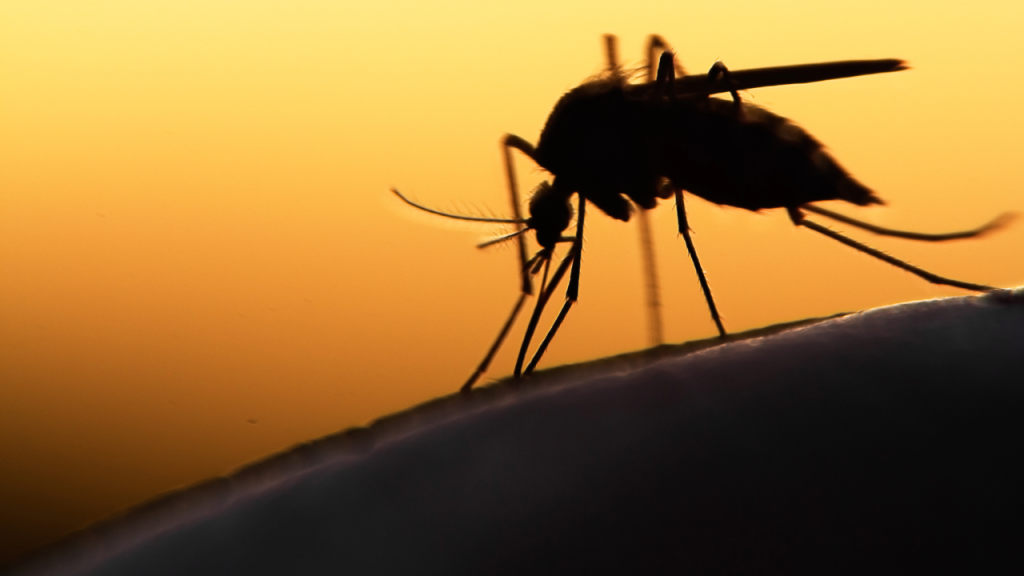
Then, I noticed a mosquito flying by my arm and promptly smashed it against my desk.
In the moment that followed, I ran through a few rationalizations for that little act of destruction.
Point 1: The mosquito could’ve been carrying a bloodborne illness. Counterpoint: Unlikely, given the region of the country where I live, but even if true, why not capture the bug and release it outside?
Point 2: I live with someone who hates bugs. Counterpoint: Well, she wasn’t in the room at the time.
Point 3: It’s not a big deal. It’s just a little bug! Who cares? Counterpoint: Wasn’t I the person just relishing in scattered stones and renegade weeds? Shouldn’t I care?
This isn’t an indictment against anyone who kills mosquitoes without a second thought (even Pope Leo swats at bugs from time to time). But it disturbed me that, for all the poetry and fiction and reflective writing that exult in Ignatian spirituality’s eternal and beautiful refrain, God in all things, for all the works that make us (read: me) so certain that we can cherish God’s presence in the unexpected and odd — for all of that, it’s disarmingly easy to flatten a mosquito.
What do we do in those moments when our values seem to wobble and we find ourselves pulled from the heights of spiritual joy to the brute bizarreness, even violence, of being a mortal creature?
Ryan Carroll
There was a part of me then (and there still is now) that wants to shake off the contradiction and return to my Mary Oliver, where one can enjoy an inoffensive imagined flower rather than a fleshly pest. But I knew, deep down, that turning away from my uncertainty — the sudden seizing fear of whether I actually act as if God is in all things — wouldn’t get anywhere.
The more I thought about it, the more I was drawn to the act of creation itself, which has everything to do (if I do it right) with dwelling in opposites.
Here’s my attempt, a little prose poem I composed as a mediative activity, attempting to reflect on the little being I’d just flattened against my cheap particleboard desk:
The average female mosquito (though of course there is no “average” mosquito, for there are more living mosquito species than there are years since Christ walked the earth, by a factor of 1.77 or so) lives fifty-odd days, and in that time lays a few hundred eggs. A few hundred mosquitoes from just one, zipping across a range of life less than two months wide.
Consider that we might then have six generations of mosquitoes in a given year, which might reasonably add up to over a thousand new mosquitoes added to the planet. Consider further that the mosquito has been around for quite some time — that mythologies of the Americas and the Asian steppe alike ascribe alien origins and malevolent influences to the great little monster — that, by scientific estimation, the oldest known mosquito, one of the primordial innovators who brought proto-culicid kind to the brave malarial era in which they now live, was entombed in amber some 99 hundred million years ago. Use those numbers to perform the magic of mathematical calculation and you come close to a recent estimate of the current global mosquito population: trillions or quadrillions of them storm about the Earth.
And yet of those trillions or quadrillions, just one is preening past your face at this very instant.
The whispering wheels that turn the world, the touch of the Spirit that has glided across the face of the Earth since before “Human” was even the blurriest dream of evolutionary possibility, set in motion a process that brought this individual insect to you, and you to it.
What will you do with it?
Turning to this question through the act of creation was, as it turns, out, illuminating. In letting words flow out from my spirit, I let my mind dwell on this thing that I had so cavalierly killed. I had no idea where my mind would go when I began to write, only that I wanted to learn and think and write about the mosquito — and it brought me to a dizzying spiritual experience. I couldn’t find a concrete answer to what I should’ve done, only, perhaps, a sense of the scale of what I did. There probably wasn’t a single answer anyway, only (as in so many things) a conversation between the Holy Spirit and me, unfolding not through a clear answer but through the act of grappling with the strange and unpleasant and repulsive — through, in short, the work of creation.
Perhaps you, too, might ask yourself how God might work with you, in the act of creativity, to feel through those moments when you act like God isn’t in quite all things.
Try This Creative Exercise:
Place your entire self, your radiant beauty and your less-than-beauty, before God. Ask God for help in finding your desires: How do you want your creative work to engage with the small, the spare and the strange? What does it mean for you to find God’s presence in the world? Spend time with God, allowing your imagination to rove over all creation, pleasant and unpleasant alike.
Where is it easy to find beauty? Where is it hard? Where is it energizing, edifying and holy? Spend time with God in this uncertainty. And when you’re ready, give thanks for the mysterious freedom of creativity, and let the Spirit who moves even through your doubts guide you where it will.