
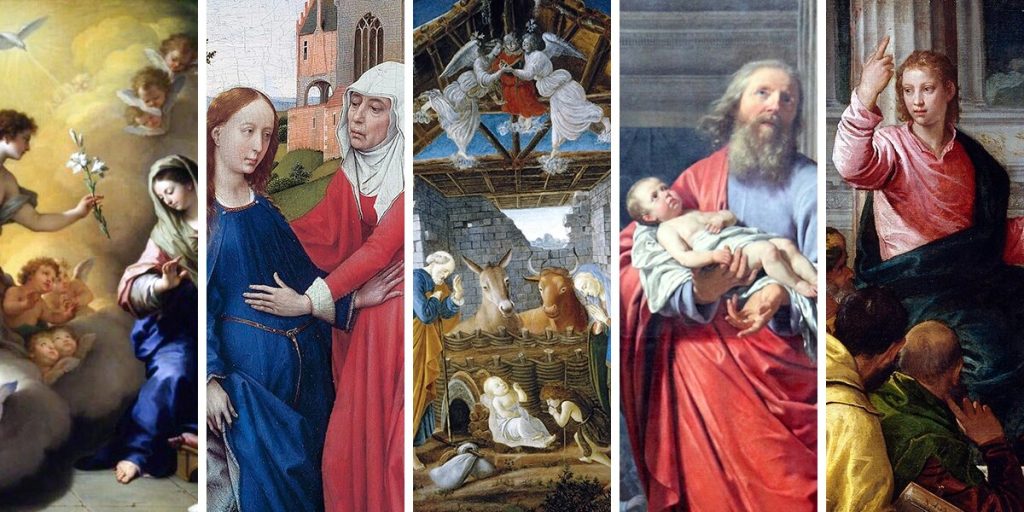

Editor’s Note: Each October, Catholics celebrate a month dedicated to the Rosary, highlighted by the Feast of Our Lady of the Rosary on October 7. This year, the Jesuit Media Lab will offer several creative works connected to the Rosary; read the first piece written by the poet and author Phil Metres and the second piece by poet and essayist Andrew Calis.
1. The Annunciation
She’s still swimming up from sleep, legs kicking for a distant bottom, so it’s a few moments before Georgia realizes the ringing isn’t in her head. Morning makes itself known by stabbing white sunlight into her just-cracked eyes, as she paws the floor beside the bed for her phone. Her vision clears but it still doesn’t make sense when she reads DAD on the faceplate.
It can’t be his monthlyish call to make sure she’s still alive; that was last week. He’s gotten better about butt-dialing. Worry propels her into a sitting position, her brain tilting slightly on its axis to let her know she’s still a little drunk from last night.
“Hey pal,” Dad says when she answers. “It’s Joy.”
That could mean so many things. Her mother’s back in rehab. Her mother’s vanished. Her mother’s back in town looking for money or reconciliation. She’s used to those calls and feels stupid for getting worried in the first place. “What now?”
“I got a call from Aunt Susie.” Joy’s sister, a woman Georgia can’t remember ever calling aunt. “She was in the hospital, and I guess she had a stroke and … well, she didn’t make it.”
Georgia waits for more. Your mother died so now she needs someone to pick her up and drive her to Akron. Your mother died so she just needs to borrow $500 until she gets back on her feet.
“She’s making the arrangements. It’ll probably be next week.” Pause. “I’m going to go.”
It’s not an invitation but it’s not an out, either.
“Okay,” Georgia says. “Just let me know. I can do whatever.”
Another pause on the other end and Georgia feels a surge of annoyance that, no matter what, she always seems to give her father the wrong answer.
2. The Visitation
“Next Thursday, in Dearborn,” Georgia tells her sister. “All Saints Church.”
Chelsea has her phone propped up against something on her kitchen counter; a fruit bowl, maybe. She stands at the stove, back to the camera, using a wooden spoon to transfer cubed potatoes from a steaming pot to a glass bowl of ice water. Bleached light from the kitchen window halos her whenever she moves to the left, and Georgia can see the graceful dome of her pregnant belly when she pivots at the waist.
“Isn’t that Catholic?” Chelsea asks. “When did she become Catholic?”
“She was always something,” Georgia says. “When she came back from that rehab in New Mexico she started going to some megachurch. She left because she slept with the pastor, but for a few months her Facebook was all end of the world and homophobia.”
Chelsea chuckles.
“There’s a wake on Wednesday, but dad can’t get down for that,” Georgia says. “If you want to go, it’d only be Thursday.”
She rolls her shoulders, trying to loosen the growing defensiveness. Chelsea will say: You have to go. It’s the right thing to go.
Chelsea says: “I’m not going.”
“What?”
For the first time since answering Chelsea turns to face the camera, a hand falling protectively over her swollen stomach. “I can’t fly like this.”
“It’s three hours from you, just drive.”
“I’m not traveling like this,” Chelsea amends. “And the boys have enough going on with sports and school, I don’t want to drag them out to…”
“Dad thinks you’re coming.” That’s a lie, but Georgia knows her father will be disappointed if at least one of his daughters isn’t there, and Georgia doesn’t want to be that one.
Chelsea turns off the stove, moves the potatoes and their ice bath onto the counter. Georgia pulls her phone closer to her, limiting how much of her apartment Chelsea can see. She doesn’t want her eyes falling on the scattered laundry, the crumpled containers, the blown-out amp serving as a bedside table.
“We reconnected a little, at the end of last year.” Chelsea leans back against the sink, both hands on her belly now. “She even met the boys once. But after that she started sending me all of these articles about how the cereal I was giving them would make them autistic. The first time I saw her shoot up I was, like, 6. But she’s worried about my kids eating Froot Loops.”
She shakes her head. “I don’t want to go there this angry at her. It’s not right.”
Only her sister could turn blowing off their mother’s funeral into a virtue.
Chelsea squints at her through the phone. “You’re not going, are you?”
“Of course I am,” Georgia says, and the rush of righteousness she feels is almost enough to make her forget that this was the last thing she wanted.
3. The Nativity
Leaning against the wall of the bar, Georgia exhales a raspberry mist of vending machine vape smoke towards the parking lot and watches it rise and scatter against the night sky. She points. “Is that a star?”
Conor squints upwards. “Surveillance satellite.”
“Sure.” Georgia feels the bass from inside rattling through the brick and drywall, shivering in her spine. “You’re really cool with canceling the gig? Because I can get out of it.”
“It’s your mom’s funeral,” Conor says. “Not like there’s gonna be record execs hanging around Slim’s Irish Pub. We can afford to lose that one.”
He hangs his head, eyes shaded by the bill of his trucker hat, and gives her that sideways smile, the one that says he wants to kiss her. Sometimes she lets him. Not tonight.
Georgia pulls her arms tight around herself, hits the vape again. Through the next exhalation she watches a semi roar past on the highway, the flickering NO VACANCY sign on the motel across the street.
“Want to hear a funny story?” Georgia asks. “The first time she disappeared was, like, hours after I was born. My dad and the nurses came back from giving me my shots or whatever and her bed was empty. She’d pulled out her IV and just, like, booked it. They call the cops, they’re looking all over for her. When they find her she’s passed out in the stairwell, like, one flight down. Just a few feet from the room the whole time.”
She laughs. Conor doesn’t.
“That’s kinda messed up,” he says.
Georgia wishes she could tell it the way her dad used to: how he made Joy seem goofy and eccentric, not a real person with real problems. But maybe it only works if you’re too young to understand.
“Yeah,” she says. “I guess it is.”
4. The Presentation
She’d expected All Saints to be dark stone and grim statues and candles, but it’s disconcertingly modern. It’s shaped, she thinks, like a circus tent with sandy wooden beams rising to a central point in the ceiling. The walls are painted a warm cream, the stained glass windows bright and impressionistic. Even the casket gleams like a new appliance.
Her father is in the front row with “Aunt” Susie and her family. Georgia waited in the parking lot until she heard music so she could sit closer to the back. Her dad will be annoyed, but does he really want her up front? She’s obviously hungover and wearing a black dress she bought at Target this morning, because nothing at home was long enough.
At the podium, a woman reads from the Bible, the phrase “blessed are” over and over. Once she finishes they all sit, and a bald, baby-faced priest takes her place. He looks more like Buddha than Jesus.
“Jesus tells his disciples what they must do to attain eternal life,” the priest says, and Georgia tunes out, running her eyes over the dozen or so mourners. Besides family, she doesn’t know any of them. Joy was living with a guy, but if he’s here he’s not drawing attention to himself. None of the men look like her type, anyway. None of these people look like her type. They’re stout, plain, on the far side of middle age. Church people. She tries to imagine Joy going to fish fries or BINGO nights or whatever it is church people do. What would Joy even talk to them about? The best place to inject so your family doesn’t see the track marks? Tips for dodging mall security guards?
The sound of her mother’s name jolts her back to the present.
“I didn’t know Joy well,” the priest says. “I mostly knew her through her works. She was a dedicated volunteer, who gave her time generously at Esperanza House. She was full of love for others, and in the faces of those she served, she saw the face of Christ. And she was happy, because she saw her salvation.”
Georgia feels the church floor pitching beneath her like the deck of a storm-pummeled ship. She fights the urge to rush the coffin and throw open its sports-car-shiny lid to make sure she’s at the right funeral. All around her, people are nodding, some even smiling in fond recognition. This was the Joy they knew? Dedicated and generous? Full of love?
She decides to confront the priest afterwards, make him confess that he says that stuff at every funeral, or that Susie wrote the speech. But when she catches sight of him, just outside of the vestibule, her father is shaking his hand, cheeks florid and moist with tears. He looks over, catches her gaze, smiles and starts to wave.
Georgia escapes out a side door and starts Googling bars in walking distance.
5. The Finding in the Temple
Joy, with her famous sense of bad timing, turns up in her dreams.
They’re back in the church. No one else is there, but the casket is. Georgia feels a flush of relief: if Joy is alive, she doesn’t have to feel guilty for hating her.
“What are you doing here?”
Joy shrugs. “Where else would I be?”
“You’re dead.”
“No.” Her mother rolls her eyes. “I told them, I was just in the stairwell. But they’d already booked the church, so…”
Georgia wakes up in her motel room still wearing her dress and one heel, her phone wedged behind the hotel room’s bedside table, battery dead. She rinses and spits in the sink three times, but her tongue still tastes like whiskey and vomit. She dresses, leaves her phone to charge, and goes for a walk.
The hangover feels like invisible thumbs pressing mercilessly into the place just above her eyebrows. She walks along the highway under a sky the color of wet cotton, the road and pavement damp with last night’s rain. Passing tires kick up a faint mist, and when she reaches All Saints the cuffs of her jeans are soaked, brushing slickly against her ankles.
In a just world the doors would be locked and she could leave. But when she pulls on a handle, it swings open.
Her mother isn’t there, of course. The church is darker than yesterday, lit only by the pale sunlight coming through the stained glass. A few women sit in the front pews to the left of the altar. Another woman leads them in prayer in, she thinks, Tagalog from the podium where the priest talked yesterday. The leader says something and the rest respond in unison, working strings of little beads through their fingers.
Georgia stands at the back, numb with embarrassment. She considers taking a seat, but the thought of the ladies inviting her forward is so mortifying that she walks right back out into the vestibule. But before she can exit, the sky springs a leak and furious rain pounds down on the parking lot.
She watches the sky for any sign of relief, but soon gets bored and starts poking around the vestibule. Posters for Catholic Charities and a local crisis pregnancy center. A stand loaded with books with titles like “What Are the Three Secrets of Fatima?” and “Gender Ideology: A Catholic Response.” Framed portraits of the pope (she recognized him) and another man wearing a magenta skullcap who she assumes is the vice pope. Then her eyes brush a word that sets her memory ringing: Esperanza.
It’s emblazoned across the top of a foam-mounted poster featuring a collage of pictures. Esperanza House. It looked like a soup kitchen: weathered men and women at tables, receiving Styrofoam dinner plates from smiling church ladies in hairnets. And there’s Joy: not serving but sitting at a table across from a bearded man wearing a camo jacket over a hoodie. It strikes Georgia for the first time how long it’s been since she’s seen her mother. She had put on weight, her once angular cheeks and chin growing soft. Joy is smiling in the picture, a shy, almost embarrassed smile. The tenderness of the image makes Georgia feel like someone punched her in the chest.
A memory forces its way up past her defenses: Joy lying in her bed, face puffy from tears. Georgia stroking her hair with a small hand, not knowing what to say but looking at her and loving her, loving her, loving her.
She’s not coming back.
The mother she lost is gone forever now. But she’s also here, and when Georgia reaches out to touch her glossy image, it feels like a reunion.
I found you, she thinks. I found you.
Author’s Statement
When I first started imagining this story, I envisioned a series of five flash fiction stories riffing on a set of Mysteries. I didn’t know what the stories were yet, or settled on which Mysteries would inspire them, but I pitched it anyway, because if I waited until my ideas were fully formed to pitch, I’d never pitch at all. As I brainstormed, I became more interested in telling one story with five vignettes that loosely followed the events of the Joyful Mysteries. This particular story was inspired by Phoebe Bridgers songs about her dad and Sufjan Stevens songs about his mom (Playlist: “Kyoto” and “Lost Weekend (Reprise)” from the former, “Romulus” and “Death With Dignity” from the latter). It’s not about the Rosary exactly (Georgia doesn’t even seem to know what one is) but in a slanted way it’s about the same thing that the Rosary is about: trying to understand and, ultimately, love your mother better.