

Editor’s Note: Each October, Catholics celebrate a month dedicated to the Rosary, highlighted by the Feast of Our Lady of the Rosary on October 7. This year, the Jesuit Media Lab will offer several creative works connected to the rosary; read the first piece written by the poet and author Phil Metres, the second piece by poet and essayist Andrew Calis, and the third piece by writer John Dougherty.

Danielle Rose Skorich was one of the first friends I made my freshman year of college. I was drawn to her because she was smart and funny and radiated joy. When she invited me to come listen to her play an open mic night, though, I was trepidatious; whenever a friend asks you to check out their art, there’s always a risk: What do we do if it’s bad?? But once Danielle started to play her guitar, I relaxed; it was immediately obvious she had true skill. And then she started to sing, and my jaw dropped. I remember thinking, “So when is she going to sign a record contract?” (The answer was “soon” — her first album came out while we were still in college.)
One of the great joys of being her friend over the years has been hearing her develop her songcraft while still holding onto the infectious joy and profound love for God that informs everything about her music. Under the stage name Danielle Rose, she spent the early years of the 2000s as a music missionary — she recorded five albums between 2001 and 2012 and traveled the world performing at parishes, conferences and events like World Youth Day. She then spent two years discerning a call to religious life and ultimately got married and started a family. She still records music, though her primary vocation at the moment is motherhood.
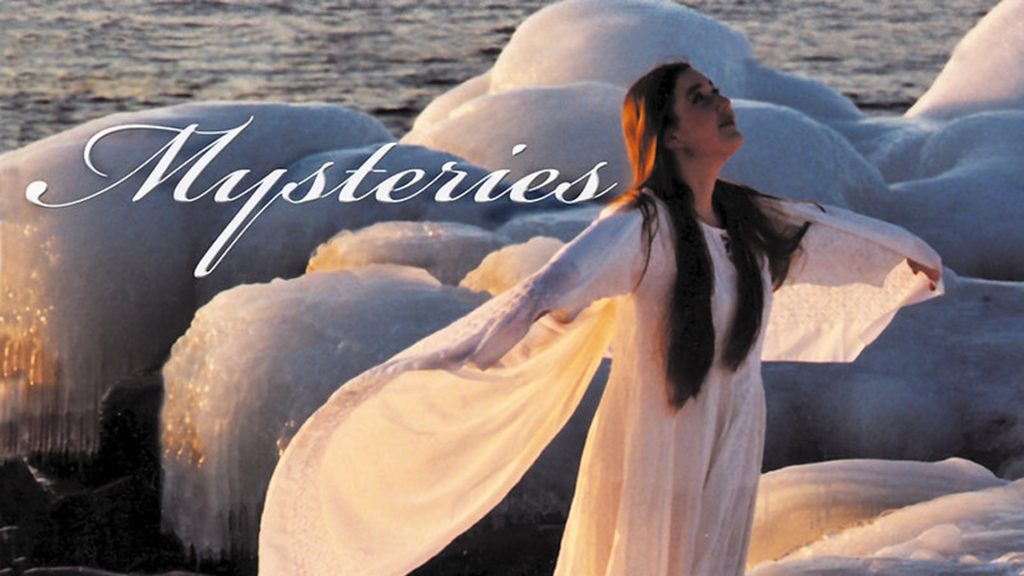
Not long after we graduated, she recorded a double album called “Mysteries,” 23 songs that cover each of the mysteries of the rosary. It came out in 2003, shortly after Pope Saint John Paul II promulgated the Luminous Mysteries. These songs are a form of the Ignatian imagination — they enter into each of the mysteries via the perspective of a character (or object) in the story — and they have helped me to visualize and pray with all the mysteries in a deeper, richer way. The album also includes the most beautiful arrangement of the “Hail Holy Queen” that I have ever heard. Since we are celebrating the rosary this month here at the Jesuit Media Lab, I reached out to Danielle to ask her about the process of writing and recording that album. I hope you enjoy our conversation (which was carried out via text, email and voice memo and has been edited for clarity and concision).
Q. “Mysteries” came out not long after Pope John Paul II announced the new Luminous Mysteries, on October 16, 2002. How did his apostolic letter inspire the genesis of the album, and your approach to writing these songs?
A. When St. John Paul II announced these new mysteries, I printed off the whole apostolic letter and went and sat at the adoration chapel in Duluth, Minnesota (where I grew up), for the entire day. As I read it, I felt this deep conviction that I wanted to answer that call of the Holy Father to help teach young people to pray the rosary again through the meditation of the mysteries coming alive; and for me as a songwriter and a missionary, I wanted to do that through the gift of songwriting.
I knew that I wanted to make those scriptural meditations for each mystery based on the perspective from a character within the scene, because that is how I had prayed with those mysteries hundreds and hundreds of times during my college years. And every day it would change; it wasn’t like I would meditate on the same aspect or perspective in the Gospel. Every day they could come alive in different ways. I prayed and asked the Holy Spirit to show me with each of the songs what character, what perspective, to take with each mystery, so that a young person could experience the creativity and the living relationships within those mysteries and the Scriptures, rather than thinking, “Oh, I already know how this all goes, and it has nothing to do with me and it’s boring.”
Q. How did the subject matter, of these 20 very different mysteries, affect your approach to songwriting?
A. St. John Paul II said that the rosary is a compendium of the Gospel, so I wanted the styles of music to be varied, so that it would reflect the diversity of the Gospel. You’ll notice the album is very eclectic. It’s not just this coherent sound of one particular genre of “singer-songwriter”; it’s a whole combination of genres, like these snapshots in the diversity of these mysteries and the life of Jesus.
I prayed first about the big picture of it: the different styles and everything like that, and then I prayed through, for each mystery, which character’s perspective to take. And then I would pray through them one at a time, for many, many months. I also had this deep conviction that the Lord wanted me to have everything written and recorded within the Jubilee Year of the Rosary (October 2002–October 2003). So that is what happened, and there was a grace that accompanied it. I would go into the chapel and spend time in adoration every day. Some days there’d be lots of words that came into the journal, and other days it would just be silence and there might be literally one or two words that would come. Each song was very different that way. And they were all a gift and a grace.
Q. Did you find it easier to write songs about any particular set of mysteries?
A. Honestly, I found the sorrowful mysteries to be the ones that came the most intuitively because in prayer, often you’re turning to the Lord in your pain and your sorrow. So as I was going through all the different types of sorrows and surrenders and sufferings of my own life, those mysteries have always been the ones that have resonated most profoundly for me.
Q. As you re-listen to these songs, how do you feel about them now?
A. Even though I listen back now and hear the youthfulness, the young sound of my voice that sounds different than it does now, I don’t look back and think, “Wow, I wish that the Holy Spirit had inspired that differently.” I think the Lord directed it and inspired it just the way that it was meant to be.
I would say it’s interesting listening back now, because when I recorded that album it was before Auto-Tune existed. So now people’s ears have been trained in a way to expect an inhuman sound of the human voice — even live performances now are manipulated digitally. So, in listening back to those recordings, I can hear the rawness and simplicity, which actually I really appreciate. It was a real live performance, and there’s something that I think is really beautiful about that. It’s just human.
Q. Do you have any insights or stories that have come about after performing these songs over the years?
A. I really believe that when God gives us a particular gift, whatever gift it might be, it’s for our own conversion, our own process of being drawn into relationship with Jesus, and that’s at the very heart of why the gift is given. And then when that gift is being used, it overflows to touch and minister to the other members of the body of Christ. And so, for me, these songs were given to me primarily for my own process of conversion and intimacy in my relationship with Jesus through Mary, through the prayer of the rosary. But the Lord has allowed that to overflow in a missionary way, and these songs have spilled over to minister to the lives of others. And that’s just a gift from God. That’s something I can’t take credit for. The Holy Spirit is the one who touches anyone’s heart, so it just has been a marvel to me through the years to hear how people have been affected personally through the witness of these songs.
Q. Would you like to share anything else about the recording of this album or its reception?
A. One special story about it is that in January of 2004, I was blessed to present the “Mysteries” album to St. John Paul II. At the time, he was very, very ill. And as those of us that were going up to present gifts to the Holy Father, he looked over at me across the stage as I was waiting. And I really did feel like he could see my soul. I had never experienced that ever in my life before, and really, I don’t think I ever have since. But I just had this deep, deep sense of him seeing my soul. It profoundly impacted me to receive that gaze of a saint. And then I went and knelt down and promised him, “I’m your messenger to the young people to take up the rosary once again.”
And so now, as a wife and mother, I’m not traveling all around the world constantly, like I had done before as a music missionary to teach people, especially young people, about the rosary, but now I’m given this opportunity to be a missionary in my own family, and to teach my children about this prayer and the beauty of it, and to try to help them to come to love and know this prayer as a heartbeat of our home. And so I’m very thankful for the gift of those mysteries coming to live in our family. And I pray that the album will continue to minister to people, however God chooses to use it.
Q. What have you been working on lately?
A. There’re so many things that I want to have come out, and there’s so little time, but the most recent two albums are “Beauty Unnoticed,” which was written in the process of grieving the loss of our daughter and son after a stillbirth and a miscarriage. It was recorded in baby steps over a period of six months during our third child’s nap time. So it was recorded very unconventionally, but I feel very grateful for how it turned out, just right from my bedroom. And then the most recent thing that was released is a setting of the Chaplet of Divine Mercy, which is a very layered recording of the different prayers related to the chaplet, and kind of just being immersed in the ocean of mercy. So those are both things I’m really excited about, and we’ll see what is to come.
Visit www.daniellerose.org to learn more.